

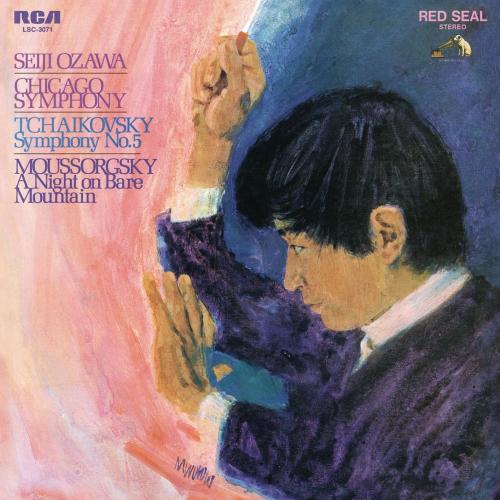
Tchaikovsky: Symphony No. 5 in E Minor, Op. 64 & Mussorgsky: A Night on Bare Mountain (Remastered) Chicago Symphony Orchestra & Seiji Ozawa
Album info
Album-Release:
1969
HRA-Release:
21.04.2017
Label: Sony Classical
Genre: Classical
Subgenre: Orchestral
Artist: Chicago Symphony Orchestra & Seiji Ozawa
Composer: Piotr Ilyich Tchaikovsky (1840-1893), Modest Petrovich Mussorgsky (1839-1881)
Album including Album cover
I`m sorry!
Dear HIGHRESAUDIO Visitor,
due to territorial constraints and also different releases dates in each country you currently can`t purchase this album. We are updating our release dates twice a week. So, please feel free to check from time-to-time, if the album is available for your country.
We suggest, that you bookmark the album and use our Short List function.
Thank you for your understanding and patience.
Yours sincerely, HIGHRESAUDIO
- 1 Symphony No. 5 in E Minor, Op. 64: I. Andante - Allegro con anima 14:06
- 2 Symphony No. 5 in E Minor, Op. 64: II. Andante cantabile con alcuna licenza 12:20
- 3 Symphony No. 5 in E Minor, Op. 64: III. Valse. Allegro moderato 05:54
- 4 Symphony No. 5 in E Minor, Op. 64: IV. Finale. Andante maestoso - Allegro vivace 11:58
- 5 Night on Bald Mountain 10:50
Info for Tchaikovsky: Symphony No. 5 in E Minor, Op. 64 & Mussorgsky: A Night on Bare Mountain (Remastered)
He is "one of those rarities, a natural conductor", exclaimed one reviewer after Seiji Ozawa's Chicago Symphony debut on July 16, 1963 at the orchestra's Ravinia Festival. "His technical facility is phenomenal, his sense of rhythm both solid and subtle, and his knowledge of scores… detailed and intimate." Another Chicago critic concurred: "His conducting technique reminds you of his teacher, Herbert von Karajan, in that it lays the score in the lap of the orchestra with transparency of gesture and human communication, then commands acceptance." At the end of the season, the 27-year-old podium sensation was appointed the festival's first-ever music director, and in the years that followed Ozawa also became a regular CSO guest at Orchestra Hall, its downtown home.
Between 1965 and 1968, he and the orchestra made a series of remarkable albums for RCA. Selected releases are now remastered form the original master tapes and releases for the first time on HighResAudio. They represent an early high-point – perhaps unsurpassed – in the Japanese maestro's long and distinguished recording career. Featured among these dynamic Ozawa/Chicago performances are three cornerstones of the symphonic repertoire: the Beethoven and Tchaikovsky Fifth Symphonies and the Schubert "Unfinished", all remastered from the original analogue tapes for this edition.
"The Chicago Symphony is one of the greatest orchestras I have ever conducted, and I have had no greater glory in music than I have experienced here." With those words, Seiji Ozawa singled out the significance of his Ravinia tenure and ensuing collaboration with the CSO.
Peter Serkin, piano
Chicago Symphony Orchestra
Digitally remastered
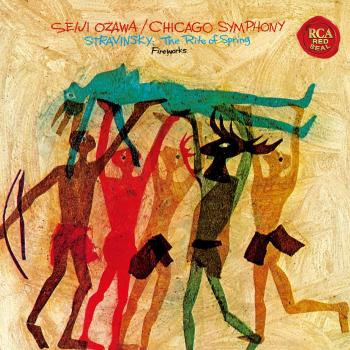
Seiji Ozawa
Born 1935 in Shenyang, China. Seiji Ozawa studied piano from a young age, and after graduating from Seijo Junior High School, he went on to study conducting under Hideo Saito at the Toho School of Music.
In 1959, he won first prize at the International Competition of Orchestra Conductors held in Besançon, France, and was invited the next summer to Tanglewood by Charles Munch, who was a judge at the competition and music director of the Boston Symphony Orchestra at the time. He proceeded to study under Karajan and Bernstein and went on to serve as assistant conductor of the New York Philharmonic, music director of the Chicago Symphony Orchestra’s Ravinia Festival, music director of the Toronto Symphony Orchestra, and music director of the San Francisco Symphony. In 1973, he became the 13th music director of the Boston Symphony Orchestra, where his tenure of 29 years was the longest in the history of American orchestras.
As music director of BSO, he built the orchestra’s reputation nationally as well as internationally, with successful concerts in Europe in 1976 and Japan in March 1978. In March 1981, BSO toured 14 cities in America to commemorate its centennial and then executed a worldwide tour in fall of the same year, with stops in Japan, France, Germany, Austria, and the United Kingdom. It went on to perform in Europe in 1984, 1988, and 1991, and Japan in 1986 and 1989, all to great acclaim.
In 1978, Ozawa was officially invited by the Chinese government to work with the China Central Symphony Orchestra for a week. A year later in March 1979, Ozawa visited China again, this time with the Boston Symphony Orchestra. In addition to orchestra performances, he facilitated significant cultural and musical exchanges through discussions and teaching sessions with Chinese musicians. He has since continued to build a strong relationship with China.
In autumn 2002, Ozawa became music director at Wiener Staatsoper, a position he held until spring 2010. His reputation and popularity are enormous in Europe, where he has conducted many orchestras including the Berliner Philharmoniker and the Vienna Philharmonic. He has also appeared in prominent opera houses such as Wiener Staatsoper in Vienna, l’Opéra National de Paris, Teatro alla Scala in Milan, Opera di Firenze, and the Metropolitan Opera in New York.
In Japan, Ozawa formed the Saito Kinen Orchestra with Kazuyoshi Akiyama in 1984 to commemorate their late mentor, Hideo Saito. The orchestra held greatly successful concerts in Tokyo and Osaka and went on to tour Europe in 1987, 1989, and 1990. In 1991, it performed concerts in Europe and America and was received with great accolades. These activities lead to the inception of Ozawa’s artistic dream in 1992: the Saito Kinen Festival Matsumoto. Ozawa became director of this international music festival, a role that continues to this day. SKO continued to tour, with overseas concerts in 1994, 1997 and 2004. From 2015, the festival has entered a new stage as the “Seiji Ozawa Matsumoto Festival”.
Ozawa has been particularly focused on education. The Chamber Music Academy Okushiga had evolved from the Saito Kinen chamber music study group sessions that started in 1997, and in 2011, this became the non-profit organization Ozawa International Chamber Music Academy Okushiga, Asia, to provide opportunities to outstanding students from countries in the region. Ozawa also founded the Seiji Ozawa Music Academy Opera Project in 2000 and the Seiji Ozawa Music Academy Orchestra Project in 2009, working actively to cultivate young musicians through performance. In 2005, he established the Seiji Ozawa International Academy Switzerland to educate European music students. Ozawa has also worked closely with the Mito Chamber Orchestra since its founding in 1990, serving as general director of the orchestra as well as director general of Art Tower Mito from 2013. He has also worked regularly with the New Japan Philharmonic since its founding.
Ozawa has won many awards in Japan and abroad, including: the Asahi Prize (1985); an Honorary Doctorate from Harvard University (2000); the Austrian Cross of Honour for Science and Art, First Class (2002); the Mainichi Art Award (2003); the Suntory Music Prize (2003); an Honorary Doctorate from the Sorbonne University of France (2004); Honorary Membership from the Wiener Staatsoper (2007); France’s Officier de la Légion d’Honneur (2008); Foreign Associated Member in the Académie des Beaux-Arts de l’Institut de France (2008); the Order of Culture, which is the highest honor in Japan (2008); Giglio D’Oro by Premio Galileo 2000 Foundation of Italy (2008); the first Japanese national to be bestowed honorary membership to the Vienna Philharmonic (2010); the Praemium Imperiale from the Japan Art Association (2011); the Akeo Watanabe Foundation Music Award (2011); and the Kennedy Center Honors (2015). In February 2016, the Ravel L’enfant et les sortilèges album conducted by Seiji Ozawa and performed by the Saito Kinen Orchestra that was recorded at the 2013 Saito Kinen Festival Matsumoto won the 58th Grammy Award for Best Opera Recording. In April 2016, he was named an Honorary Member of the Berliner Philharmoniker.
This album contains no booklet.