



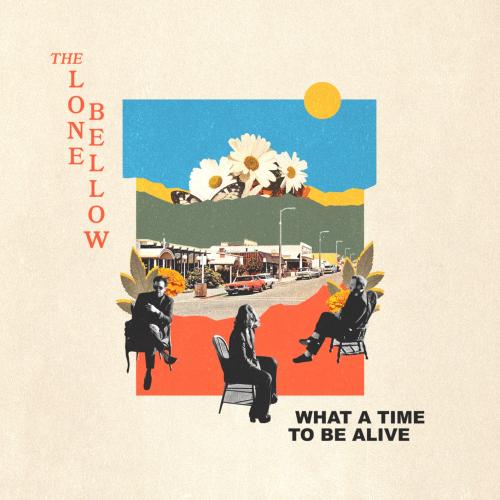
What A Time To Be Alive The Lone Bellow
Album info
Album-Release:
2026
HRA-Release:
13.02.2026
Album including Album cover
- 1 After The Rain 03:13
- 2 I Did It For Love 04:19
- 3 You Were Leaving 04:30
- 4 Common Folk 04:10
- 5 No Getting Over You 03:57
- 6 Say 04:43
- 7 Staring At The Sun 03:54
- 8 Night Goes Black 03:06
- 9 Honeysuckle 03:08
- 10 Islands In The Stream 04:04
- 11 I'm Here For You 03:42
- 12 What A Time To Be Alive 03:59
Info for What A Time To Be Alive
With their sixth studio album, What A Time To Be Alive, The Lone Bellow embarks on a bold new chapter while honoring the deep bonds that have defined their journey. Written collaboratively for the first time with their full touring band—founding members Zach Williams, Brian Elmquist, and Kanene Pipkin joined by drummer Julian Dorio and multi-instrumentalist Tyler Geertsma—the album channels the raw, ecstatic energy of the band’s live show into a dynamic collection of songs that pulse with warmth, honesty, and human connection.
Recorded live in Muscle Shoals, AL, after a writing retreat in a converted Kentucky firehouse, the album is both a celebration and a reckoning: of friendship, loss, love, and resilience. From the gritty, Stones-tinged opener “After The Rain” to the soul-stirring closer “What A Time To Be Alive,” the record captures the joy and vulnerability that have long defined The Lone Bellow’s sound—lush harmonies, heartfelt lyrics, and genre-blurring arrangements steeped in folk, rock, and gospel.
The album’s creation was marked by setbacks, including the theft of early recordings, but the outpouring of support from their fanbase reaffirmed what the band has always known: their music is a shared experience. That spirit echoes throughout the album, whether in anthems like “Common Folk” and “I’m Here For You,” or in intimate reflections like “You Were Leaving” and “Night Goes Black.”
Since their acclaimed 2013 debut, The Lone Bellow has appeared on The Tonight Show, Austin City Limits, and The Late Show, topped Americana charts, and headlined storied venues from Carnegie Hall to the Ryman Auditorium.
But with their next album, they reaffirm their commitment not just to making music, but to building community—on stage, in song, and around the table.
Zach Williams, guitar, lead vocals
Kanene Donehey Pipkin, mandolin, bass, keyboard, vocals
Brian Elmquist, guitar, vocals
Additional musicians:
Julian Dorio, drums
Tyler Geertsma, various instruments
The Lone Bellow
Throughout their lifespan as a band, The Lone Bellow have cast an indelible spell with their finespun songs of hard truth and unexpected beauty, frequently delivered in hypnotic three-part harmony. In a departure from their past work with elite producers like Aaron Dessner of The National and eight-time Grammy-winner Dave Cobb, the Nashville-based trio struck out on their own for their new album Love Songs for Losers, dreaming up a singular sound encompassing everything from arena-ready rock anthems to the gorgeously sprawling Americana tunes the band refers to as “little redneck symphonies.” Recorded at the possibly haunted former home of the legendary Roy Orbison, the result is an intimate meditation on the pain and joy and ineffable wonder of being human, at turns heartbreaking, irreverent, and sublimely transcendent.
“One of the reasons we went with Love Songs for Losers as the album title is that I’ve always seen myself as a loser in love—I’ve never been able to get it completely right, so this is my way of standing on top of the mountain and telling everyone, ‘It’s okay,’” says lead vocalist Zach Williams, whose bandmates include guitarist Brian Elmquist and multi-instrumentalist Kanene Donehey Pipkin. “The songs are looking at bad relationships and wonderful relationships and all the in-between, sometimes with a good deal of levity. It’s us just trying to encapsulate the whole gamut of experience that we all go through as human beings.”
The fifth full-length from The Lone Bellow, Love Songs for Losers arrives as the follow-up to 2020’s chart-topping Half Moon Light—a critically acclaimed effort that marked their second outing with Dessner, spawning the Triple A radio hits “Count On Me” and “Dried Up River” (both of which hit #1 on the Americana Singles chart). After sketching the album’s 11 songs in a nearby church, the band holed up for eight weeks at Orbison’s house on Old Hickory Lake, slowly carving out their most expansive and eclectic body of work yet. “I’ve always thought our music was so much bigger than anything we’ve shown on record before, and this time we turned over every stone until we got the songs exactly where they needed to be,” says Elmquist. Co-produced by Elmquist and Jacob Sooter, Love Songs for Losers also finds Pipkin taking the reins as vocal producer, expertly harnessing the rarefied vocal magic they’ve brought to the stage in touring with the likes of Maren Morris and Kacey Musgraves. “Singing together night after night for a decade allows you to understand what your bandmates are capable of, in a way that no one else can,” says Pipkin. “There are so many different qualities to our voices that had never been captured before, and producing this album ourselves was a nice opportunity to finally showcase that.”
Recorded with their longtime bassist Jason Pipkin and drummer Julian Dorio, Love Songs for Losers embodies an unvarnished intensity—an element in full effect on its lead single “Gold,” a galvanizing look at the real-life impact of the opioid crisis. “We don’t ever try to write songs with an agenda, so with ‘Gold’ the idea was to tell the story from the perspective of someone in a hard situation—in this case, a guy who’s stuck in the downward spiral of addiction,” says Elmquist. In one of the most exhilarating turns on Love Songs for Losers, the chorus to “Gold” explodes in a wild collision of bright piano tones, potent beats, and massively stacked guitars. “We’ve sung ‘Gold’ as a folk song in the past, but for the album we wanted to really experiment and push our sound as far as it could go,” Elmquist notes.
Imbued with equal parts brutal honesty and heart-expanding wisdom, Love Songs for Losers opens on “Honey” and its synth-laced reflection on the more delicate aspects of enduring love. “‘Honey’ came from thinking about how my wife doesn’t like being called ‘honey’ or ‘baby’—she thinks it’s lazy, it always rubs her the wrong way,” says Williams. “It turned into a song about sometimes wanting to go back to when we were first in love, when everything was crazy and exciting and we were right on the verge of ruining each other’s lives at any second.” Later, on “Cost of Living,” Pipkin takes the lead vocal and shares a raw and lovely expression of grief, her voice shifting from fragile to soulful with impossible ease. A quietly shattering piano ballad featuring Elmquist on lead vocals, “Dreaming” channels the ache of lost love with exquisite specificity. “It’s a song about two people catching up with each other, and I love how the lyric goes from ‘How’s your mother?’ to ‘How’s that devil in your heart?’—there’s no middle ground, which feels very true to me,” says Williams. And on “Wherever Your Heart Is,” The Lone Bellow present a beautifully slow-building piece exploring a particularly powerful form of devotion. “I love those moments, even in friendships, when someone surprises you or reveals something you never knew about them before,” says Elmquist. “I think it’s so vital to any relationship to keep on chasing the mystery and maintain that curiosity, instead of just making your mind up about who or what the other person is.”
One of the most tender tracks on Love Songs for Losers, “Unicorn” unfolds with a cascade of heavenly melodies as Williams offers up an unabashed outpouring of affection for his wife Stacy (“I was kinda thinkin’ I could tell you my feelings/Sit you down and wreck you with some words that are pretty/I could say ‘I love you’ but I wanna say more/I think God made a unicorn”). “That’s definitely one where the physical location seeped into the song, and Roy Orbison’s ghost maybe led us toward the path we ended up on,” Williams points out.
Even in its most lighthearted moments, Love Songs for Losers bears the same heady depth of emotion that’s guided Williams since his earliest days as a songwriter—a period of time that followed a devastating horse-riding accident that left Stacy temporarily paralyzed. As she recovered, Williams learned to play guitar and began setting his journal entries to song, routinely performing at an open-mic night across the street from the hospital. Soon after Stacy regained her ability to walk, the couple moved to Brooklyn, where (after eight years as a solo artist) Williams joined Elmquist and Pipkin in founding The Lone Bellow. In 2013, the band made their auspicious debut with a self-titled, Charlie Peacock-produced album that quickly landed at No. 64 on the Billboard 200, later turning up on best-of-the-year lists from the likes of Paste and Pop Matters. With over 100 million career streams to date, The Lone Bellow’s past output also includes the Dessner-produced Then Came the Morning (a 2015 effort that earned them an Americana Music Award nomination) and Walk Into a Storm (a 2017 release produced by Cobb and hailed by NPR for its “warmly rousing, gospel-inflected Americana”).
For The Lone Bellow, the triumph of completing their first self-produced album marks the start of a thrilling new chapter in the band’s journey. “At the outset it was scary to take away the safety net of working with a big-name producer and lean on each other instead,” says Pipkin. “It took an incredible amount of trust, but in the end it was so exciting to see each other rise to new heights.” And with the release of Love Songs for Losers, the trio feel newly emboldened to create without limits. “This album confirmed that we still have beauty to create and put out into the world, and that we’re still having fun doing that after ten years together,” says Elmquist. “It reminded us of our passion for pushing ourselves out onto the limb and letting our minds wander into new places, and it sets me on fire to think of what we might make next.”
This album contains no booklet.