
OperaCréole Ensemble, Opera Lafayette Orchestra & Patrick Dupre Quigley
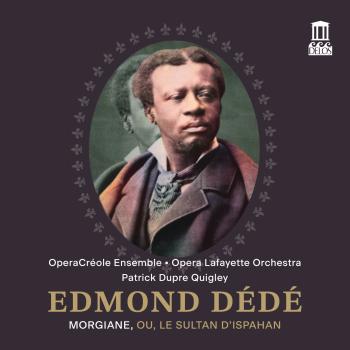
Biographie OperaCréole Ensemble, Opera Lafayette Orchestra & Patrick Dupre Quigley
Patrick Dupre Quigley
conductor, producer, arranger, composer, is Founder and Artistic Director of Miami’s Seraphic Fire, and Artistic Director Designate of the Washington, D.C.-based period instrument opera company Opera Lafayette.
Quigley is known for his engaging performances of historically-informed programming that draw in new audiences and delight regular concertgoers. A ceaseless advocate for a more inclusive concert experience, Quigley’s programs regularly span more than 1000 years of musical history. Through recordings, performances, and new editions, Quigley has championed the culturally relevant voices of Spanish Renaissance composer Tomas Luis de Victoria, the 11th century polymath and saint Hildegard of Bingen, and 18th century Cuban composer Esteban Salas y Castro. He is currently editing the first edition of Edmond Dédé's 1887 French grand opera, Morgiane, the earliest known complete opera by a Black American. Quigley deeply respects music traditions outside the Western European canon and has developed concerts and collaborations highlighting the music of the Babylonian Jews, New Orleans’s Black Gospel tradition, Latin Pop, and the Baroque music of North and South America.
Recent and upcoming programs include Bach’s orchestral suites and violin concerti with the Orchestra of St. Luke’s and Gil Shaham at Carnegie Hall, Pergolesi’s Stabat Mater and La Servante Maîtresse with Opera Lafayette at the John F. Kennedy Center for the Performing Arts, return engagements with the Charlotte Symphony and Chicago’s Music of the Baroque, conducting debuts with the Baltimore Symphony Orchestra, Canada’s National Arts Centre Orchestra, the St. Louis Symphony Orchestra and the Rhode Island Philharmonic, plus scenes from Jean-Philippe Rameau’s Castor et Pollux with Seraphic Fire.
Other guest conducting invitations have come from The Cleveland Orchestra, Grand Rapids Symphony, Hamilton Philharmonic, Indianapolis Symphony, Kansas City Symphony, Louisiana Philharmonic, Mobile Symphony, ARTIS Naples, New Jersey Symphony, New World Symphony, Philharmonia Baroque Orchestra, San Antonio Symphony, San Francisco Symphony and the Utah Symphony.
Quigley, along with co-founder Joanne N. Schulte, established the indie-classical ensemble Seraphic Fire in 2002. The ensemble presents a full season of live concerts of historical and contemporary music in Miami-Dade, Broward, Palm Beach, and Collier counties. Seraphic Fire invests in its own local, regional, state, and national communities through its education programs running from 3rd grade through post-graduate level students. The ensemble has most recently commissioned works by Alvaro Bermudez, Sydney Guillaume, and Tawnie Olson; and has given modern, regional, national, international, and recording premieres of contemporary and historical works by Hildegard of Bingen, Shawn Crouch, Susan Labarr, Tomas Luis de Victoria, Nico Muhly, Esteban Salas y Castro, Greg Spears, Christopher Theofanidis, and Ileana Perez Velazquez, among others. The Seraphic Fire Media recording catalogue contains 16 titles, representing diverse musical voices: Two titles have received Grammy nominations. The ensemble has also recorded with the international pop star Shakira.
Quigley holds an undergraduate degree in Music Theory and History from the University of Notre Dame, studying under Daniel Stowe, Alexander Blachly, and Walter Ginter. Quigley studied conducting with Marguerite Brooks while earning a Master of Music degree at the Yale School of Music. He has assisted Michael Tilson Thomas in rehearsals, performances, and recordings at the San Francisco Symphony. Quigley is a native of New Orleans, Louisiana, and currently resides in Washington, D.C.
Opera Lafayette Orchestra
is an American period instrument ensemble that specialises in French repertoire, rediscovers masterpieces, and creates a recorded legacy of its work. Founded in 1995 in Washington, DC, by conductor and artistic director Ryan Brown, Opera Lafayette has earned critical acclaim and a loyal following for its performances and recordings with international singers renowned for their interpretations of baroque and classical operas.
Opera Lafayette’s performances included Vivaldi’s Catone in Utica, Chabrier’s Une Éducation Manquée (An Incomplete Education), and Opera and the French Revolution: Three dramatic scenes from Œdipe à Colone by Antonio Sacchini, Sapho by Jean-Paul-Égide Martini (a modern première), and Médée by Luigi Cherubini.
At the invitation of Château de Versailles Spectacles, Opera Lafayette made its international début at the Opéra Royal in February 2012 with the modern world première of Monsigny’s Le Roi et le fermier. Opera Lafayette returned to Versailles for five sold-out performances of Mozart’s Così fan tutte and Philidor’s Les Femmes Vengées in January and February of 2014.
Opera Lafayette’s discography on the Naxos label has expanded to twelve releases, including Gluck’s Orphée et Euridice (2005), Sacchini’s Œdipe à Colone (2006), Rameau Operatic Arias (2007), Lully’s Armide (2008), Rebel and Francœur’s Zélindor, roi des Sylphes (2009), Monsigny’s Le Déserteur (2010), Philidor’s Sancho Pança (2011), Grétry’s Le Magnifique (2012), Monsigny’s Le Roi et le fermier (2012), Félicien David’s Lalla Roukh (2014), Philidor’s Les Femmes Vengées (2015), and Grétry’s L’épreuve villageoise (2016).
OperaCreole Ensemble
Opera and classical music in New Orleans and worldwide have always included the contributions of persons of color. Since the 19th century, Creoles of New Orleans have contributed to the city's music and culture. It is their participation in opera, as well as the music of Africa, Spain, and Haiti, that contributed to the birth of jazz.
Our award-winning nonprofit, founded in 2011 by the mother-and-daughter team of Givonna Joseph and Aria Mason, is dedicated to researching and performing lost or rarely performed works by composers of African descent. The company focuses on works by free 19th-century New Orleans composers of color and also promotes Louisiana's Creole language and culture.
The word Créole means "native to the place"; and, in keeping with the spirit of the word, OperaCréole's singers are professional artists, educators, and international soloists with roots in New Orleans, America's "First City of Opera!" (The first opera performed in what is now the United States took place in New Orleans in 1796.)
OperaCréole's groundbreaking work, including the 2017 production of Lucien Lambert's lost opera La Flamenca (1903), has been acknowledged nationally by NPR (National Public Radio), The New Yorker, and the AfriClassical Blog. In 2017, our founders were named among the Southerners of the Year by Southern Living, and OperaCréole has received numerous awards for contributions to the operatic sphere.