






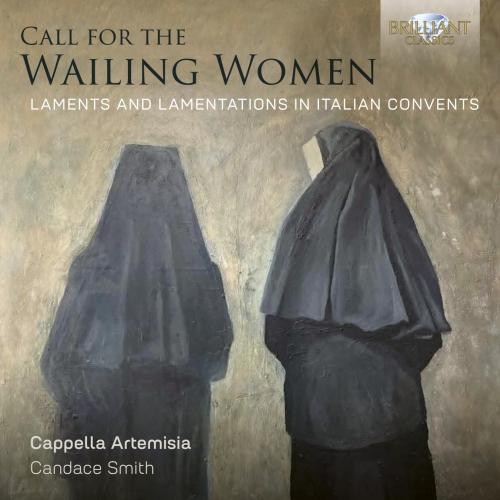
Call for the Wailing Women, Laments and Lamentations in Italian Convents Cappella Artemisia & Candace Smith
Album Info
Album Veröffentlichung:
2026
HRA-Veröffentlichung:
23.01.2026
Label: Brilliant Classics
Genre: Classical
Subgenre: Vocal
Interpret: Cappella Artemisia & Candace Smith
Komponist: Carlo Donato Cossoni (1623-1700), Alessandro Della Ciaia (1605-1670), Giovanni Matteo Asola (1532-1609), Chiara Margherita Cozzolani (1602-1677), Agostino Guerrieri (1630-1684), Lucrezia Orsina Vizzana (1590-1662), Giovanni Battista Strata (1579-1651)
Das Album enthält Albumcover Booklet (PDF)
- Carlo Donato Cossoni (1623 - 1700): Morior Misera (From Motetti a Due E Tre Voci, Op. 1, Venice 1665, Rep. 1678):
- 1 Cossoni: Morior Misera (From Motetti a Due E Tre Voci, Op. 1, Venice 1665, Rep. 1678) 07:51
- Alessandro Della Ciaia (ca.1605 - 1670): Feria Quinta, Lamentatione Prima (From Lamentationi Sagre, E Motetti Ad Una Voce Col Basso Continuo, Venice 1650):
- 2 Ciaia: Feria Quinta, Lamentatione Prima (From Lamentationi Sagre, E Motetti Ad Una Voce Col Basso Continuo, Venice 1650) 09:03
- Giovanni Matteo Asola (1524 - 1609): Lamentationes in Coena Domini (From Lamentationes, Improperia, Et Alia Sacrae Laudes, Venice 1588 in Alternation with Anon:
- 3 Asola: Lamentationes in Coena Domini (From Lamentationes, Improperia, Et Alia Sacrae Laudes, Venice 1588 in Alternation with Anon: Lamentatione Di Geremiah (From Canti Delle Monache, Bologna 1670) 04:42
- Chiara Margarita Cozzolani (1602 - 1678): Quid Miseri, Quid Faciamus? (From Concerti Sacri a 1-4 Voci, [Op.2, Venice, 1642]:
- 4 Cozzolani: Quid Miseri, Quid Faciamus? (From Concerti Sacri a 1-4 Voci, [Op.2, Venice, 1642] 07:34
- Agostino Guerrieri (1630 - 1685): Sonata Malinconica (From Sonate Di Violino [...] Per Chiesa, & Anco Aggionta Per Camera, Venice 1673):
- 5 Guerrieri: Sonata Malinconica (From Sonate Di Violino [...] Per Chiesa, & Anco Aggionta Per Camera, Venice 1673) 04:21
- Lucrezia Orsina Vizzana (1590 - 1662): Usquequo Oblivisceris Me in Finem? (From Componimenti Musicali Di Motteti Concertati a Una, Due, Tre E Quattro Voci..., Venice 1623):
- 6 Vizzana: Usquequo Oblivisceris Me in Finem? (From Componimenti Musicali Di Motteti Concertati a Una, Due, Tre E Quattro Voci..., Venice 1623) 02:59
- Giovanni Battista Strata: Deh, Che Fai, Anima Mia (From Arie Di Musica [...] Per Concertare Con Voci E Strumenti, Genoa, 1610):
- 7 Strata: Deh, Che Fai, Anima Mia (From Arie Di Musica [...] Per Concertare Con Voci E Strumenti, Genoa, 1610) 04:02
- Maria Francesca Nascimbeni (1640 - 1680): O Trafitto Mio Dio (From Canzoni E Madrigali Morali, E Spirituali. A Una, Due E Tre Voci, Ancona 1674):
- 8 Nascimbeni: O Trafitto Mio Dio (From Canzoni E Madrigali Morali, E Spirituali. A Una, Due E Tre Voci, Ancona 1674) 10:21
- Anonymous: La Monaca Musica (From MS. Mo G239, Biblioteca Estense, Modena):
- 9 Anonymous: La Monaca Musica (From MS. Mo G239, Biblioteca Estense, Modena) 09:32
- Alessandro Della Ciaia: Lamentatio Virginis in Depositione Filij De Cruce (From Sacri Modulatus Ad Concentum..., Op. 3, Bologna 1666):
- 10 Ciaia: Lamentatio Virginis in Depositione Filij De Cruce (From Sacri Modulatus Ad Concentum..., Op. 3, Bologna 1666) 15:58
Info zu Call for the Wailing Women, Laments and Lamentations in Italian Convents
World-premiere recordings of motets by a host of unknown names from the early Italian Baroque: the latest result of performing scholarship by a group with a notable track record of success in this repertoire.
International critics have praised the 'expert performances' (Gramophone) of Cappella Artemisia, and the intrepid adventurousness of the ensemble's founder, Candace Smith, in turning up one buried treasure after another, most of them to be found in the music libraries of Italian convents. The latest fruits of her research have turned up lamentations by Carlo Donato Cossoni, Alessandro Della Ciaia, Giovanni Matteo Asola, Chiara Margarita Cozzolani, Agostino Guerrieri, Lucrezia Orsina Vizzana, Giovanni Battista Strata, Maria Francesca Nascimbeni, Alessandro Della Ciaia - and the best known name among them, Anonymous.
All the pieces here and probably all the composers will be unfamiliar even to those well versed in Baroque-era highways and byways, such as Brilliant Classics has catalogue so comprehensively over the last quarter-century. As Candace Smith observes in her insightful booklet essay, the practice of lamenting - voicing grief - has been associated with women since time immemorial. This album presents a sequence of laments and lamentations from 16th- and 17th-century Italy as they might have been sung in that most exclusively female environment: the convent.
Several of these laments belong to the long tradition of Passiontide compositions to which composers from Gesualdo to Macmillan have contributed, in setting texts from the Book of Lamentations which belong to the liturgy of Maundy Thursday, Good Friday and Holy Saturday. Still other pieces are sacred madrigals setting more contemporary texts, such as O trafitto mio Dio: the work of the 16-year-old Maria Francesca Nascimbeni, before she took the veil. Musical life was often remarkably rich behind the convent walls. One traveller to Genoa 1592 encountered a young nun who could play the organ, the violin and the lira da gamba, as well as singing beautifully and resembling 'more an angel than a woman'. Thus this album presents a tiny sample of that culture: one which should entrance listeners on account both of the beauty of the unknown music, as well as the hidden stories behind it's composition.
Maria Dalia Albertini, soprano
Silvia Vajente, soprano
Anna Simboli, soprano
Elena Biscuola, mezzo-soprano
Elena Carzaniga, mezzo-soprano
Candace Smith, mezzo-soprano
Chiara Brunello, mezzo-soprano
Marina De Liso, mezzo-soprano
Mya Fracassini, mezzo-soprano
Olivia Centurioni, violin
Maria Christina Cleary, baroque harp
Claudia Pasetto, viola da gamba
Annalisa Pappano, lirone
Miranda Aureli, organ
Maria Luisa Baldassari, harpsichord
Cappella Artemisia
Candace Smith, artistic direction
Cappella Artemisia
Nearly all the nunneries practice music, both playing numerous sorts of musical instruments, and singing. And in some convents there are such rare voices that they seem angelic, and like sirens entice the nobility of Milan to go and hear them. (Paolo Moriggi, 1595)
Throughout the late 16th and 17th centuries, the chronicles of historians and travelers in Italy provide images of a fabulous musical world inhabited by women – singers, players and even composers. Such images are all the more intriguing, considering the truly draconian restrictions governing virtually every aspect of these cloistered women’s lives, especially their music. Moreover, a veil of mystery surrounds this repertoire: the music written by and for the nuns often includes parts for tenor and bass voices, and the use of instruments was officially forbidden in the convents. How was this music performed?
Cappella Artemisia is an ensemble of female singers and instrumentalists that attempts to provide some answers to this question. Dedicated to performing the music from Italian convents in the 16th and 17th centuries, its repertoire includes both forgotten works composed by the nuns themselves, as well as music intended for performance in the convents by better-known male composers, but presented here for the first time as it would originally have been heard, i.e., without male voices.
Since its inception in 1991, Cappella Artemisia has received critical and popular praise both for the rarity and originality of its repertoire and for the high quality of its performances. It has appeared at some of the most prestigious European and North American festivals of early music and its concerts and recordings have been broadcast on radios throughout Italy, Europe and North America. The ensemble has ventured into the 18th century with the first performance in modern times of the oratorio Jahel by Baldassare Galuppi, composed for the girls of the Venetian Ospedale dei Mendicanti (in collaboration with the Orchestra Barocca di Bologna). And in addition to their traditional repertoire of music from Italian convents, the singers of the ensemble were also involved in a modern staging of Purcell’s Dido and Aeneas in an all-women’s performance recalling that of 1689 at a fashionable boarding school in Chelsea for “Young Gentlewomen”.
Cappella Artemisia takes its name from the painter, Artemisia Gentileschi, a striking figure in 17th-century Italy whose artistic accomplishments are finally beginning to be recognized. We hope, under her auspices, to bring this same recognition to the neglected musical achievements of her forgotten contemporaries within the convent walls.
Booklet für Call for the Wailing Women, Laments and Lamentations in Italian Convents