

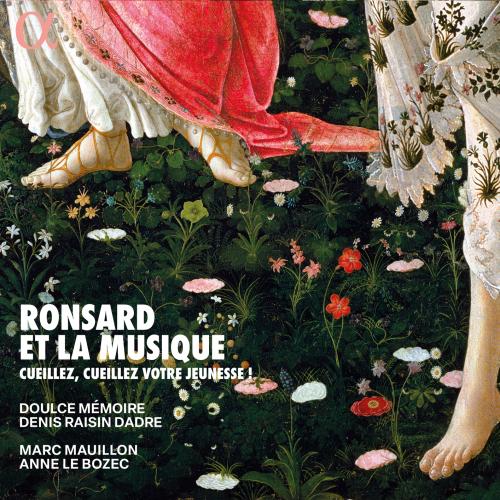
Ronsard et la musique. Cueillez, cueillez votre jeunesse! Doulce Mémoire & Denis Raisin Dadre
Album Info
Album Veröffentlichung:
2024
HRA-Veröffentlichung:
06.09.2024
Label: Alpha Classics
Genre: Classical
Subgenre: Vocal
Interpret: Doulce Mémoire & Denis Raisin Dadre
Komponist: Antoine Gardane (1508-1569), Guillaume Boni (1530-1594), Orlando di Lasso (Lassus) (1532-1594), Jean de Castro (1540-1600), Andreas Pevernage (1543-1591), Anthoine de Bertrand (1540-1581), Clement Janequin (1472-1559), Philippe de Monte (1521-1603), Pierre Phalese (1510-1575), Claude Goudimel (1510-1572), Jehan Chardavoine (1537-1580)
Das Album enthält Albumcover Booklet (PDF)
- Anonymous: Que dis-tu, que fais-tu, pensive tourterelle:
- 1 Anonymous: Que dis-tu, que fais-tu, pensive tourterelle: Texte récité à la lyre 01:55
- Antoine Gardane (1509 - 1569): Que dis-tu, que fais-tu, pensive tourterelle (I):
- 2 Gardane: Que dis-tu, que fais-tu, pensive tourterelle (I) 03:03
- Bor Zuljan (b. 1969):
- 3 Zuljan: Improvisation au luth (I) 00:50
- Guillaume Boni (1530 - 1594): Que dis-tu, que fais-tu, pensive tourterelle (II):
- 4 Boni: Que dis-tu, que fais-tu, pensive tourterelle (II) 04:19
- Orlando di Lasso (1532 - 1594): Que dis-tu, que fais-tu, pensive tourterelle (III):
- 5 Lasso: Que dis-tu, que fais-tu, pensive tourterelle (III) 02:58
- Bor Zuljan: Improvisation au luth (II):
- 6 Zuljan: Improvisation au luth (II) 00:45
- D'Entraigues: Que dis-tu, que fais-tu, pensive tourterelle (IV):
- 7 D'Entraigues: Que dis-tu, que fais-tu, pensive tourterelle (IV) 03:23
- Jean de Castro (1540 - 1611): Que dis-tu, que fais-tu, pensive tourterelle (V):
- 8 Castro: Que dis-tu, que fais-tu, pensive tourterelle (V) 03:35
- Anonymous: Je suis tellement amoureux:
- 9 Anonymous: Je suis tellement amoureux: Texte récité à la lyre 02:31
- Andreas Pevernage (1542 - 1591): Je suis tellement amoureux:
- 10 Pevernage: Je suis tellement amoureux 03:55
- Jean de Castro: Chansons, odes, et sonetz de Pierre Ronsard: Je suis tellement amoureux:
- 11 Castro: Chansons, odes, et sonetz de Pierre Ronsard: Je suis tellement amoureux 03:55
- Anthoine de Bertrand (1540 - 1581): Second livre des amours de Pierre de Ronsard:
- 12 Bertrand: Second livre des amours de Pierre de Ronsard: No. 7, Je suis tellement amoureux 02:38
- Anonymous: Bon jour mon coeur, bon jour ma douce vie:
- 13 Anonymous: Bon jour mon coeur, bon jour ma douce vie: Texte récité à la lyre 01:56
- Orlando di Lasso: Bon jour mon coeur, LV 167:
- 14 Lasso: Bon jour mon coeur, LV 167 01:16
- Andreas Pevernage: Bon jour mon coeur, bon jour ma douce vie (I):
- 15 Pevernage: Bon jour mon coeur, bon jour ma douce vie (I) 02:36
- Clément Janequin (1485 - 1558): Nature ornant la Dame:
- 16 Janequin: Nature ornant la Dame 02:36
- Jean de Castro: Bon jour mon coeur, bon jour ma douce vie (II):
- 17 Castro: Bon jour mon coeur, bon jour ma douce vie (II) 01:41
- Bor Zuljan: Improvisation au luth (III):
- 18 Zuljan: Improvisation au luth (III) 00:36
- Philippe de Monte (1521 - 1603): Bon jour mon coeur, bon jour ma douce vie (IV):
- 19 Monte: Bon jour mon coeur, bon jour ma douce vie (IV) 01:44
- Pierre Phalese (1510 - 1573): Bon jour mon coeur, bon jour ma douce vie:
- 20 Phalese: Bon jour mon coeur, bon jour ma douce vie: Allemande 01:40
- Claude Goudimel (1510 - 1572): Bon jour mon coeur, bon jour ma douce vie (V):
- 21 Goudimel: Bon jour mon coeur, bon jour ma douce vie (V) 01:53
- Anonymous: Mignonne, allon voir si la rose:
- 22 Anonymous: Mignonne, allon voir si la rose: Texte récité à la lyre 02:39
- Bor Zuljan: Improvisation au luth (IV):
- 23 Zuljan: Improvisation au luth (IV) 00:52
- Jehan Chardavoine (1538 - 1580): Mignonne, allon voir si la rose:
- 24 Chardavoine: Mignonne, allon voir si la rose 01:51
- Guillaume Costeley (1530 - 1606): Mignonne, allon voir si la rose:
- 25 Costeley: Mignonne, allon voir si la rose 02:23
- Didier Le Blanc (1575 - 1585): Amour dis-moi de grâce:
- 26 Blanc: Amour dis-moi de grâce 01:28
- Pierre Clereau (d. 1570): Mignonne, allon voir si la rose:
- 27 Clereau: Mignonne, allon voir si la rose: Pierre Clereau 01:53
- Pierre Phalese: Mignonne, allon voir si la rose:
- 28 Phalese: Mignonne, allon voir si la rose: Allemande et courante 01:19
- Rinaldo del Mel (1554 - 1598): Mignonne, allon voir si la rose:
- 29 Mel: Mignonne, allon voir si la rose: Rinaldo del Mel 04:54
- Fabrice Marin Caiétain (1540 - 1578): Mignonne, allon voir si la rose:
- 30 Caiétain: Mignonne, allon voir si la rose: Fabrice Marin Caietain 01:25
- Paul Lacôme (1838 - 1920): Vingt mélodies:
- 31 Lacôme: Vingt mélodies: No. 5, Que dites-vous mignonne 02:45
- Charles Gounod (1818 - 1893): Heureux sera le jour, CG 388:
- 32 Gounod: Heureux sera le jour, CG 388 03:41
- Clémence de Grandval (1828 - 1907): 6 Nouvelles mélodies:
- 33 Grandval: 6 Nouvelles mélodies: No. 4, Mignonne 03:05
- Jacques Durand (1865 - 1928): 2 Poèmes de Ronsard:
- 34 Durand: 2 Poèmes de Ronsard: No. 1, Espérance 01:48
- Camille Saint-Saëns (1835 - 1921): 5 Poèmes de Ronsard:
- 35 Saint-Saëns: 5 Poèmes de Ronsard: No. 4, Grasselette et Maigrelette 02:05
- Albert Groz (1827 - unknown): Les amours de Marie, Op. 8:
- 36 Groz: Les amours de Marie, Op. 8: No. 1, Bonjour mon cœur 02:09
- 37 Groz: Les amours de Marie, Op. 8: No. 2, Marie qui voudrait votre nom retourner 03:29
- 38 Groz: Les amours de Marie, Op. 8: No. 3, Mais voyez mon cher émoi 02:46
- 39 Groz: Les amours de Marie, Op. 8: No. 4, Vous méprisez nature 03:28
- 40 Groz: Les amours de Marie, Op. 8: No. 5, Le printemps n'a point tant de fleurs 02:00
- 41 Groz: Les amours de Marie, Op. 8: No. 6, ouvre-moi ton sein 04:10
- Maurice Ravel (1875 - 1937): Tombeau de Ronsard:
- 42 Ravel: Tombeau de Ronsard: No. 8, Ronsard à son âme 02:56
- Jacques Ibert (1890 - 1962): Chanson du départ de Don Quichotte:
- 43 Ibert: Chanson du départ de Don Quichotte 02:56
- Théodore Gouvy (1819 - 1898): 40 Poésies de Ronsard:
- 44 Gouvy: 40 Poésies de Ronsard: No. 27, Bonjour 01:53
- 45 Gouvy: 40 Poésies de Ronsard: No. 7, Que dites-vous, que faites-vous, mignonne 02:16
- Pauline Viardot (1821 - 1910): Bonjour mon cœur!, VWV 1072:
- 46 Viardot: Bonjour mon cœur!, VWV 1072 01:20
- Paul Dukas (1865 - 1935): Tombeau de Ronsard:
- 47 Dukas: Tombeau de Ronsard: No. 6, Sonnet 03:15
- Arthur Honegger (1892 - 1955): Tombeau de Ronsard:
- 48 Honegger: Tombeau de Ronsard: No. 5, Chanson 01:26
- 4 Chansons pour voix grave, H. 184:
- 49 Honegger: 4 Chansons pour voix grave, H. 184: No. 4, La terre les eaux va buvant 01:00
- Camille Saint-Saëns: 5 Poèmes de Ronsard:
- 50 Saint-Saëns: 5 Poèmes de Ronsard: No. 5, L'amant malheureux 02:05
- Théodore Gouvy: 40 Poésies de Ronsard:
- 51 Gouvy: 40 Poésies de Ronsard: No. 32, Du grand Turc je n'ai souci 03:04
- Francis Poulenc (1899 - 1963): À sa guitare, FP 79a:
- 52 Poulenc: À sa guitare, FP 79a 02:32
- Cécile Chaminade (1857 - 1944): Mignonne:
- 53 Chaminade: Mignonne 02:30
- Théodore Gouvy: 40 Poésies de Ronsard:
- 54 Gouvy: 40 Poésies de Ronsard: No. 17, Rossignol, mon mignon 03:03
- Alfredo Casella (1883 - 1947): Sonnet:
- 55 Casella: Sonnet 03:19
Info zu Ronsard et la musique. Cueillez, cueillez votre jeunesse!
Das Jahr 2024 markiert den 500. Geburtstag von Ronsard, der als "Prince des Poètes" bekannt wurde und dessen Gedichte im Laufe der Jahrhunderte mehr als vierhundert Mal vertont wurden. Das von Denis Raisin Dadre kuratierte Programm vergleicht mehrere Vertonungen desselben Sonetts durch Komponisten des 16. Jahrhunderts (Gardane, Lassus, Castro, Bertrand, Costeley) und durch spätere Komponisten wie Charles Gounod, Camille Saint-Saëns, Paul Dukas, Maurice Ravel, Théodore Gouvy, Pauline Viardot und Arthur Honegger, die sich allesamt drei Jahrhunderte später von demselben "Bonjour mon cœur" und dem berühmten "Mignonne, allon voir si la rose" haben inspirieren lassen. Eine faszinierende Playlist mit Liedern, die von einem Genie inspiriert wurden, dessen "beau style bas, populaire et plaisant" die Zeit überdauert hat. Die Ensemblemitglieder von Doulce Mémoire lassen die Renaissance-Vertonungen wieder aufleben, während der Sänger Marc Mauillon und die Pianistin Anne Le Bozec die Lieder aus dem 19. und 20. Jahrhundert präsentieren.
Philippe Vallepin, Rezitator
Clara Coutouly, Sopran
Camille Fritsch, Mezzosopran
Olivier Coiffet, Viola
Brice Claviez-Homberg, Alt
Hugues Primard, Tenor
François-Olivier Jean, Tenor
Marc Busnel, Bass
Bor Zuljan, Laute, Renaissance-Gitarre
Baptiste Romain, Lyra
Sébastien Wonner, Spinett
Denis Raisin Dadre, Flöte, künstlerische Leitung
Doulce Mémoire
represents above all the spirit of the Renaissance – a time of discoveries, inventions, voyages, creativity... For more than thirty years now, this close-knit and loyal team of musicians and singers has been involved in artistic ventures of a constantly innovative nature, with the regular participation of actors and dancers. The ensemble’s productions range from the Splendeurs de la Renaissance programme, featuring the very serious Missa pro victoria by Tomás Luis de Victoria, to the mischievous and musicologically irresponsible Le Cri du tournebout or the re-creation of festivities at the royal court of François I in Magnificences à la cour de France.
Ever since it came into being, Doulce Mémoire has appeared at national theatres, opera houses and festivals all over France, as well as in many major cities abroad. Always game for new challenges, the ensemble has also performed at more unusual venues: on the forecourt of a cinema in the heart of Paris, in front of the prestigious Taipei Palace Museum, in the grounds of the Sultans’ Palace in Istanbul, or precariously balanced on a barge in the Tahiti Lagoon.
Through its concerts and staged performances, Doulce Mémoire enables audiences to discover music that could have been heard by great men of the Renaissance such as Leonardo da Vinci, Michelangelo, Rabelais, François I and others, some of whom were very infl uential in the Loire Valley and left their mark on some of its famous Renaissance châteaux. Particularly active in that part of France, the ensemble has developed a special relationship with the Centre-Val de Loire Region and the Château de Chambord.
In the course of its travels, Doulce Mémoire has encountered artists with whom it has forged wonderful personal and artistic relationships; these include the Hunan Shadow Theatre in China, the Portuguese fado singer António Zambujo, the Iranian singer Taghi Akhbari, and Sanjay Khan and Amrat Hussain, specialists in traditional Indian music. Such encounters provide an opportunity to show how easily Renaissance music can travel and create exchanges and interactions with the music of other cultures. Programmes and recordings such as Laudes (Christian laude and Sufi chant) and Les Nuits de Jaipur (in which the Ars Subtilior of the Visconti court in Milan meets North Indian ragas) are perfect illustrations.
Doulce Mémoire records for the labels Alpha Classics, Ricercar and Le Printemps des Arts de Monte-Carlo. Its recordings have received many distinctions: Diapason d’Or de l’Année, Choc du Monde de la Musique, ƒƒƒƒ Télérama, and so on. The ensemble has also taken part in a number of audiovisual documentaries.
Denis Raisin Dadre
After his musical studies – recorder, oboe and musicology – Denis Raisin Dadre formed the ensemble Doulce Mémoire in 1989. His keen interest in history, literature, and the arts in general, as well as music, led him to devise programmes set in a historical context.
His career included memorable achievements both in concert and on record; his love for the Renaissance never weakened. As Denis Raisin Dadre studied the material found in European libraries, and transposed manuscript scores or tried out various instrumental possibilities, he questioned preconceived ideas and sometimes even the vocabulary of music – and not only that of the Renaissance, for he often worked with stage directors and choreographers on the creation of original types of performance.
He was regularly invited to take part in academies organised for the training of young musicians. Denis Raisin Dadre taught, for example, at those of Gijon (Spain), Chiquitos (Bolivia), Prague (Czech Republic) and Havana (Cuba). He also taught in the Department of Early Music at the Conservatoire in Tours.
Denis Raisin Dadre was made a Chevalier des Arts et des Lettres by the French Ministry of Culture in 1999.
Denis Raisin Dadre died in September 2025, at the age of 69.
Booklet für Ronsard et la musique. Cueillez, cueillez votre jeunesse!