



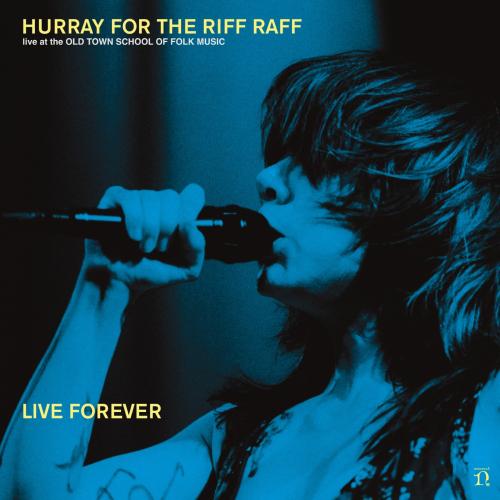
Live Forever Hurray for the Riff Raff
Album Info
Album Veröffentlichung:
2026
HRA-Veröffentlichung:
20.03.2026
Das Album enthält Albumcover
Entschuldigen Sie bitte!
Sehr geehrter HIGHRESAUDIO Besucher,
leider kann das Album zurzeit aufgrund von Länder- und Lizenzbeschränkungen nicht gekauft werden oder uns liegt der offizielle Veröffentlichungstermin für Ihr Land noch nicht vor. Wir aktualisieren unsere Veröffentlichungstermine ein- bis zweimal die Woche. Bitte schauen Sie ab und zu mal wieder rein.
Wir empfehlen Ihnen das Album auf Ihre Merkliste zu setzen.
Wir bedanken uns für Ihr Verständnis und Ihre Geduld.
Ihr, HIGHRESAUDIO
- 1 Alibi (Live) 03:18
- 2 Hawkmoon (Live) 03:33
- 3 Rhododendron (Live) 04:10
- 4 Dynamo (Live) 03:56
- 5 Buffalo (Live) 05:11
- 6 Colossus of Roads (Live) 03:07
- 7 Snake Plant (The Past Is Still Alive) [Live] 05:15
- 8 Precious Cargo (Live) 05:54
- 9 Pyramid Scheme (Live) 03:15
- 10 Vetiver (Live) 04:58
- 11 The World Is Dangerous (Live) 06:26
- 12 Hourglass (Live) 04:32
- 13 Ogallala (Live) 06:36
- 14 Pa'lante (Live) 08:15
Info zu Live Forever
Hurray for the Riff Raff releases "Live Forever", a new live record on the exact two-year anniversary of The Past Is Still Alive—named one of the Best Albums of the 2020s So Far by Pitchfork, and one of the Best Albums of 2024 by the New York Times, Atlantic, Associated Press, NPR Music, Rolling Stone, Billboard, Out, Mojo, Uncut, and a multitude of others.
Live Forever was captured over the course of two sold-out summer nights at the Old Town School of Folk Music in bandleader Alynda Segarra’s new home of Chicago. Spanning 14 songs, Live Forever presents The Past Is Still Alive in its entirety, as well as a selection of Hurray for the Riff Raff’s show-stopping, set-defining staples: decrying ICE on the poetic “Precious Cargo” and The Navigator’s anthemic “Pa’lante”; the prescient digital age critique of “Pyramid Scheme”; and ripping through a folk-rock rendition of LIFE ON EARTH’s “Rhododendron”.
“I moved to Chicago in September 2024, the year I released The Past Is Still Alive and hit the road with a new band—a group of musicians recommended by my front of house/production manager, Johnny Wilson. Everyone had ties to the city, and had been playing together in the DIY scene for over a decade," Alynda Segarra says. "Since then we’ve traveled the world together, becoming family, playing the best shows of my life. Chicago has become home for me, and I feel grateful for the welcome I’ve gotten into the best music scene in the country.
"I wanted to capture this time and this brilliant band, a moment that won’t last forever. This record is a love letter to the working class musicians out there, we who slug it out on the road against all odds. We deserve so much more from an industry built to exploit us. It’s a thank you to all the fans supporting live music, you who believe songs made by human beings are a vital life force. Thank you.”
Fronted by Alynda Segarra (they/them), Live Forever features the musicians from Hurray for the Riff Raff’s latest touring lineup—Parker Grogan (electric guitar, vocals), Nnamdi Ogbonnaya (bass, backing vocals), Marcus Drake (drums) and Sen Morimoto (saxophone, keyboards), produced by Johnny Wilson. In addition to hundreds of tour dates behind The Past Is Still Alive, they have played the stages of Jimmy Kimmel Live!, Austin City Limits, The Kelly Clarkson Show, CBS Saturday Morning, Newport Folk Festival and more, while recently sharing bills with everyone from Waxahatchee and MJ Lenderman to Ani DiFranco, Bright Eyes, Orville Peck, Soccer Mommy and The Head and the Heart.
Hurray for the Riff Raff (Alynda Segarra), vocals, acoustic guitar
Parker Grogan, electric guitar, backing vocals
Nnamdi Ogbonnaya, bass, backing vocals
Marcus Drake, drums
Sen Morimoto, saxophone, keyboards
Live sound by Johnny Wilson
Recording Engineer: Steve Marek
Recording dates: July 17 & 18, 2025
Recording studio & location: Old Town School of Folk Music (Chicago, IL)
Editor(s): Jonny Wilson & Steve Marek
Mixing Engineers: Steve Marek & Johnny Wilson
Mix studio, location: Cybernetic Meadow Recording (Chicago, IL)
Mastering engineer: Heba Kadry
Mastering studio & location: Heba Kadry (Brooklyn, NY)
Please Note: We offer this album in its native sampling rate of 48kHz, 24-bit. The provided 96kHz version was up-sampled and offers no audible value!
Alynda Segarra
is 36, or a little less than halfway through the average American lifespan. In that comparatively brief time, though, the Hurray for the Riff Raff founder has been something of a modern Huck Finn, an itinerant traveler whose adventures prompt art that reminds us there are always other ways to live.
Born in the Bronx and of Puerto Rican heritage, Segarra was raised there by a blue-collar aunt and uncle, as their father navigated Vietnam trauma and their mother neglected them to work for the likes of Rudy Giuliani. They were radicalized before they were a teenager, baptized in the anti-war movement and galvanized in New York’s punk haunts and queer spaces. At 17, Segarra split, becoming the kid in a communal squat before shuttling to California, where they began crisscrossing the country by hopping trains. They eventually found home—spiritual, emotional, physical—in New Orleans, forming a hobo band and realizing that music was not only a way to share what they’d learned and seen but to learn and see more. Hurray for the Riff Raff steadily rose from house shows to a major label, where Segarra became a pan-everything fixture of the modern folk movement. But that yoke became a burden, prompting Segarra to make the probing and poignant electronic opus, 2022’s Life on Earth, their Nonesuch debut. Catch your breath, OK? We’re back to 36, back to now.
During the last dozen years, these manifold tales of Segarra’s voyages have shaped an oral folklore of sorts, with the teenage vagabonding or subsequent trainhopping becoming what some may hear about Hurray for the Riff Raff before hearing the music itself. Segarra has dropped tidbits in songs, too, but they always worried that their experiences were too radical, that memories of dumpster diving or riding through New Orleans with a dildo dangling on an antenna were too much. But on The Past Is Still Alive, Segarra finally tells the story themselves, speckling stirring reflections on love, loss, and the end or evolution of the United States with foundational scenes from their own life. “It felt like a trust fall, or a letting go of this idea of proving something to the music industry—how I can be more digestible, modifiable, sellable,” Segarra says. “I feel like I’m closer to what I actually have to share.”
There is, for instance, sex and communal musicmaking on an island of San Francisco trash during “Snake Plant (The Past Is Still Alive),” a charged attempt to reckon the erosion of our childhood innocence with a belief that a worthwhile future is still possible. Or there are the cops and the trains and the long walks down empty Nebraska highways to escape said cops during “Ogalla,” the cathartic closer that tries to maintain the spirit of the past while actually surviving in the now. The Past Is Still Alive is the record of Segarra’s life so far, not only because it chronicles the past to understand the present but also because it is the most singular and magnetic thing Hurray for the Riff Raff have yet made. A master work of modern folk-rock, The Past Is Still Alive resets the terms of that tired term.
In March 2023, when Segarra returned to the North Carolina studio of producer Brad Cook to cut The Past Is Still Alive, they weren’t so sure about the session, if they could even handle it. Only a month before, their father, Jose Enrico (Quico) Segarra, had died. A musician himself, he had long been fundamental to Segarra’s songs, a point of inspiration and encouragement. What’s more, Segarra had made Life on Earth with Cook, and drummer Yan Westerlund had long toured in Hurray for the Riff Raff. But much of the band they’d assembled for these sessions—guitarist Meg Duffy, fiddler Libby Rodenbough, saxophonist Matt Douglas, multi-instrumentalist Phil Cook—were unknown quantities. At the edge of catastrophe and in the headlock of grief, could Segarra share these bone-deep songs among strangers? “The songwriting is what drove me. I didn’t feel the need to try to transform,” Segarra reckons. “It felt like the truth of where I was at in my life—very vulnerable, very fair, very raw.”
Segarra simply let those complex feelings lead the way, hurling themselves into these excavations of memory and blueprints for what’s to come. Witness, for instance, the tensile resolve in opener “Alibi,” a yearning reflection on addicted childhood friends that pleads with them to join the land of the living while they still can. As the pedal steel moans beneath the snappy country shuffle, their voice frays, a testament to the way they’re bearing difficult witness. That call to survival returns in “Snake Plant,” a song so stuffed with specific childhood memories—scenes from family road trips to Florida, snapshots from discovering oneself on the edge of the world—that Segarra feels like an actual tour guide. “Test your drugs/remember Narcan,” they sing toward the end. “There’s a war on the people/What don’t you understand?” The demand is graceful and winning, not pedantic, lived-in advice from someone who has managed to live when so many friends have not.
This quest to live in spite of outside attempts to kill us off animates “Colossus of Roads,” at once the most devastating and uplifting entry in the entire Hurray for the Riff Raff catalogue. Written like an urgent dispatch after the Club Q shooting in Colorado, it is a paean to the outsiders, a love song for the vulnerable—the queer, the homeless, the radical. Their voice taut as a piece of barbed wire, Segarra deploys poet Eileen Myles and boxcar artist BuZ blurr (the Colossus of Roads himself) to suggest a sanctuary of solidarity for the dispossessed. The United States as we know it can and probably should dissolve, they seethe; as it all comes down, though, Segarra asks to “wrap you up in the bomb shelter of my feather bed.” Brilliantly written and rendered, it is an anthem for a dawning age of collective liberation. “I’ve only had this experience a couple of times, where a song falls on me—it’s all there, and I don’t do anything,” Segarra admits. “It felt like creating a space where all us outsiders can be safe together. That doesn’t exist, but it exists in our minds, and it exists in this song.”
Throughout The Past Is Still Alive, Segarra suggests the profound ability to navigate all this pain, chaos, and trauma, or at least to meet it with senses of wonder and want. To wit, the delightful “Buffalo” uses the iconic American mammal that Americans almost drove to extinction as a metaphor for a new love; can it survive the pressures of society? A duet with Conor Oberst, “The World Is Dangerous” is a heartbroken waltz that still offers to hold someone close, if and when they’re ready.
And even as Segarra tells the tale of the first trans women they ever met, Miss Jonathan in New Orleans, and the beatings they took during “Hawkmoon,” they seem to beam, advocating for a better world yet to come. “I’m becoming the kind of girl that they warned me about,” Segarra sings at the end with devilish aplomb, proud to be carrying on Miss Jonathan’s work of upending norms, whether by sharing Miss Jonathan’s story or simply taking up space for themselves and their own multitudes.
It is especially fraught these days to speak of art in terms of national identity, to flirt with a jingoism that has led to new autocrats and rekindled old wars. But in the best ways possible, The Past Is Still Alive is a distinctly American record, built on twin pillars of peril and promise that have forever been foundational to this country.
The wanderlust that leads to piñon fires near the pueblos of New Mexico’s high desert and all-night escapades in New Orleans. The independence that shapes communities of like-minded outcasts, looking after one another. The inequality that makes such enclaves essential, that makes one of us eat out of garbage and the other with a silver spoon: It is all tragically and beautifully bound inside The Past Is Still Alive. Just as Louise Erdrich has done of late with Native Americans, Lonnie Holley with African-Americans, and Julie Otsuka with Asian-Americans, Segarra expands the scope of American stories here, stretching a long-safeguarded circle to encompass outsiders forever on the fringes. “The past is still alive/The root of me lives in the ballast by the mainline,” Segarra sings at one point, sweeping their days of riding rails directly into whatever success they have found now. Hurray for the riff raff, indeed.
Dieses Album enthält kein Booklet