





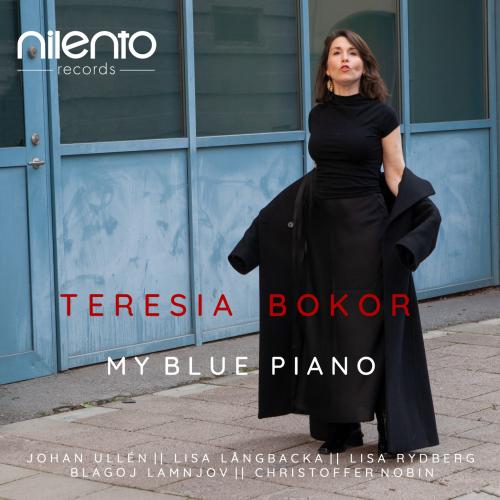
My Blue Piano Teresia Bokor
Album Info
Album Veröffentlichung:
2025
HRA-Veröffentlichung:
23.01.2026
Label: Nilento Records
Genre: Classical
Subgenre: Vocal
Interpret: Teresia Bokor
Komponist: Bella Bartók (1881-1945), Vítězslava Kaprálová (1915-1940), Bedrich Smetana (1824-1884), Gyorgy Ligeti (1923-2006), Staffan Storm (1964), Christoffer Nobin (1978)
Das Album enthält Albumcover
- Christoffer Nobin (b. 1978): Prelude:
- 1 Nobin: Prelude 01:09
- New York:
- 2 Nobin: New York 02:01
- Béla Bartók (1881 - 1945): Elindultam szép hazámból:
- 3 Bartók: Elindultam szép hazámból 01:46
- Vítězslava Kaprálová (1915 - 1940): Paris:
- 4 Kaprálová: Paris 02:35
- Navždy:
- 5 Kaprálová: Navždy 02:17
- Bedřich Smetana (1824 - 1884): Intermezzo:
- 6 Smetana: Intermezzo 01:16
- Vítězslava Kaprálová: Ruce:
- 7 Kaprálová: Ruce 01:40
- Christoffer Nobin: Wien:
- 8 Nobin: Wien 02:23
- György Ligeti (1923 - 2006): Der Sommer:
- 9 Ligeti: Der Sommer 02:41
- Blagoj Lamnjov: No homeland:
- 10 Lamnjov: No homeland 01:13
- Staffan Storm (b. 1964): Jerusalem:
- 11 Storm: Jerusalem 02:30
- Der große Engel:
- 12 Storm: Der große Engel 05:58
- Christoffer Nobin: Postlude:
- 13 Nobin: Postlude 01:10
Info zu My Blue Piano
My Blue Piano explores feelings of loneliness, belonging and rootlessness touching on what it means to live and create in exile. The music on the album brings together three Central European composers, Béla Bartók, Vítězslava Kaprálová, and György Ligeti, each of whom was forced to leave their homeland or prevented from returning.
Running throughout the album are poems by Else Lasker-Schüler who lived in Jerusalem during the Second World War. It was there she wrote her final collection of poetry, Mein Blaues Klavier, which gives the album its title. Lasker-Schüler was a poet who both provoked and impressed, a striking presence on the streets of Jerusalem, whose flamboyant lifestyle and eccentric dress never quite found a place in her new city.
The album is structured in four acts – New York, Paris, Wien and Jerusalem – cities where Bartók, Kaprálová, Ligeti and Lasker-Schüler each lived in exile.
New York: This act opens with a clarinet solo, a nod to the beginning of Gershwin’s Rhapsody in Blue, where cultural expressions merge and blend. Here, American and Hungarian musical traditions meet in a new shared soundscape. The clarinet, along with other instruments associated with Hungarian folk music, creates a sonic world filled with memory and longing.
Béla Bartók left his beloved homeland during World War II and lived in exile in New York. The Hungarian folk song Elindultam szép hazámból ("I’m fleeing my beloved homeland") stayed with him throughout his life and holds a central place in this act.
Paris: Czech composer and conductor Vítězslava Kaprálová was never able to return to her homeland. On Christmas night in 1939, her Prélude de Noël was broadcast from Paris to an occupied Czechoslovakia. A melody from this work returns in this act, set against a Parisian backdrop where longing for love is deeply felt. A version of Smetana’s Moldau, by Kaprálová’s fellow countryman, also weaves together two of her songs.
Wien: This act features fragments of Beethoven’s Egmont Overture, a piece frequently played on Hungarian radio during the 1956 revolution. That same year, György Ligeti fled Hungary hidden aboard a postal train, later settling in exile in Vienna.
His song Der Sommer (“The Summer”) evokes green fields slowly fading into autumn. As the train travels across the Hungarian plains, playful clarinet lines suggest transience and the feeling of having no true homeland.
Jerusalem: The album’s final act takes us to Jerusalem, where Staffan Storm’s composition Der große Engel sets Else Lasker-Schüler’s poem War sie der große Engel to music. Here, the circle closes in an atmosphere where rootlessness may itself carry a sense of belonging.
Teresia Bokor, soprano
Blagoj Lamnjov, clarinet
Lisa Långbacka, accordeon
Lisa Rydberg, violin
Johan Ullen, piano
Christoffer Nobin, musical director
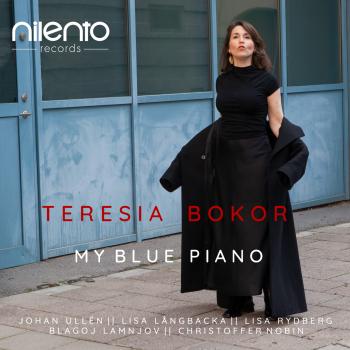
Teresia Bokor
Acclaimed for her striking beauty of tone, commanding stage presence, and remarkable coloratura, Teresia Bokor has established herself as a highly appreciated soprano. Being of Swedish-Hungarian origin, she has a strong affinity towards the central European musical tradition, beside her passion for Italian opera.
Highlights of her stage carrier include Servilia in La clemenza di Tito at the Royal Danish Opera under Lars Ulrik Mortensen with stage director David McVicar, Gilda in Rigoletto at Norrlandsoperan under Rumon Gamba, Fiorilla in Il Turco in Italia at Läckö Slottsopera, Micaëla in Carmen with the Nordic Wind Ensemble, Christine in The Phantom of the Opera at Det Ny Teater in Copenhagen with stage director Arthur Masella, and the Queen of the night in The magic flute at the Folkoperan in Stockholm, a performance which rendered her the Soloist prize, and Salmo XIX by Niccolò Castiglioni with the Danish National Symphony Orchestra under Gianandrea Noseda.
Other operatic highlights include Der Rosenkavalier at the Royal Danish Opera conducted by Michael Schønwandt, Les enfant et les sortilèges by Maurice Ravel conducted by Thomas Søndergaard, Gli amore d’Apollo e di Dafne by Franco Cavalli conducted by Benjamin Bayl and a concert production of Carmen with the Helsingborg Symphony Orchestra conducted by Pier Giorgio Morandi.
Teresia is a regular guest at the Malmö Opera, where she has appeared in several roles over the past years including Der Sandmann and Das Taumännchen in Hänsel und Gretel, Rowan in The Little Sweep by Benjamin Britten, Paribanu in Tusen och en natt by Swedish contemporary composer Daniel Fjällström, and Séraphine in Les surprises de l’enfer by Isabelle Aboulker.
Recent seasons has seen her debut at Den Fynske Opera in Denmark and her Norwegian debut as Clorinda in La Cenerentola with Opera Østfold. During her tenure as a member of the soloist ensemble at Landestheater Linz, Austria, she appeared in roles such as Olympia in Les contes d’Hoffmann, Mi in Das Land des Lächelns by Franz Lehár, and Bubikopf in Der Kaiser von Atlantis by Viktor Ullmann, as well as in concert performances at the Bruckner house of Ein Deutsches Requiem by Johannes Brahms and Carmina Burana by Carl Orff together with the Bruckner Orchestra.
With her remarkable tessitura and musical accuracy, she is a strong interpreter of much contemporary music. She appeared as a soloist in The voice of a daughter with the Royal Stockholm Philharmonic Orchestra under Tobias Ringborg at Konserthuset in Stockholm, during Composer’s weekend 2019 dedicated to Tommie Haglund. Teresia also appeared as a soloist in the same piece at the Tommie Haglund International Festival in 2022 under Joachim Gustafsson and The Bogotá Philharmonic Orchestra. Teresia’s performance of Salmo XIX by Niccolò Castiglioni with the Danish National Symphony Orchestra under Gianandrea Noseda is released on Chandos. Furthermore she has performed in several operatic world premieres, notably Stilla min eld at Piteå Kammaropera and Lille Soldat at Den Fynske Opera.
As a concert singer she appears regularly with orchestras in the Nordic countries – Malmö Symphony Orchestra, Helsingborg Symphony Orchestra, Norrköping Symphony Orchestra, Dalasinfoniettan, Concerto Copenhagen and the Royal Swedish Navy Band to name a few – as well as in Austria, Hungary, Germany, Poland and New York.
Teresia performs in Trio Bokor, Carlsson och Bock together with countertenor Daniel Carlsson and lutenist Fredrik Bock. The trio appears on chamber music stages in Sweden and Denmark, including the renowned Båstad Chamber Music Association and The Nydahl Collection. Their repertoire spans from Renaissance music to contemporary works by Swedish composers.
In the fall of 2025, Teresia's debut solo album will be released, featuring music by, among others, Vítězslava Kaprálová, Béla Bartók, György Ligeti, and Swedish composer Staffan Storm. Contributing musicians on the album include pianist Johan Ullén, accordionist Lisa Långbacka, and violinist Lisa Rydberg.
Dieses Album enthält kein Booklet