





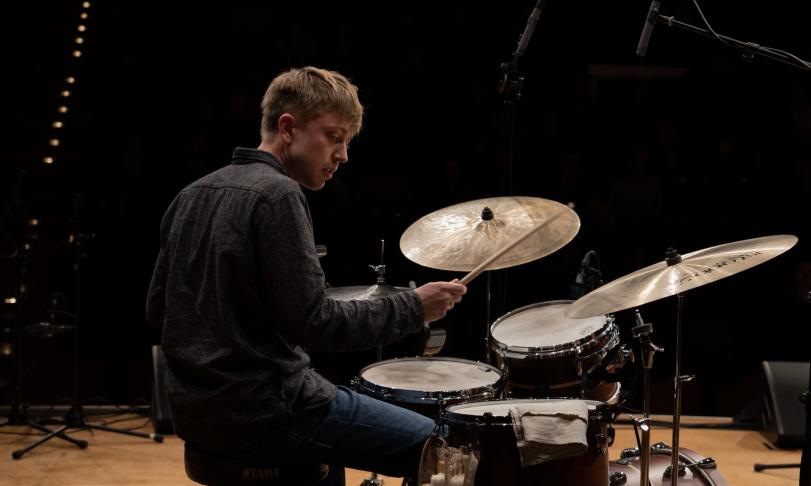
The Jazz Thing Next Generation series from Jazz Thing magazine continues to actively discover outstanding talents in the jazz scene and pave the way for them to break into the market. The latest addition to the series is David Giesel with his album *Echoes of the Unknown*, a remarkable addition in many ways to the collection, which now comprises 110 full-length albums.
The 41 minutes and 37 seconds of the finest jazz pieces were recorded in just two days. The producer was Paolo Almeida, a Brazilian drummer who has lived in Basel since 2019 and teaches at the city’s Jazz Campus. He helped Giesel shape his ideas and translate them into sonic worlds with guitarist Albin Ormegard, pianist Moritz Langmeier, and double bassist Thomas Fuller.
What’s great about Echoes of the Unknown is that it’s not an album for drum nerds. It’s also pleasing, however, that the drums are given equal space—allowing them to express themselves with force and impact where appropriate, and to subtly shape the action from the background elsewhere, thus showcasing their dynamic potential as a valuable asset. Such an approach is rather rare in the world of sound, as is the pronounced bass presence of the bass drum, which comes across with a rich, full-bodied sound.
The approach used to record parts of the album is also interesting. The members of the Wuartett are friends, so some elements are not compositions but ad-hoc events. This includes the opening of “Trial and Error,” the album’s first track. It is an improvisation, a spontaneous jam by Giesel, about which he says he only realized in hindsight what he had done. He did it well.
Also excellent is the delicate drumming on “Day Dream,” which blends superbly with the fading and swelling tones of the guitar to create a tapestry of sound that opens up space for the piano and double bass to weave their interplay. The same applies to “Where Nothing Is Certain and That’s Okay,” which also delights with a charming bass solo.
“My Heart Is Dancing Into The Universe” has a different character, carried by the guitar, whose melodic playing runs through the track. The guitar and piano share the role of melodic carrier on “This Is for Jim,” a ballad that brings a sense of calm to the musical flow. The lively “Moods” stands out somewhat, as Dea Bryant’s spoken vocals slow down toward the end into a surprising contemplativeness.
The recording of “Echoes of the Unknown” is impressively transparent, clear, and tangible. All eight tracks present themselves on a stage brought close to the listener, which can be classified somewhere between a club atmosphere and a chamber music quartet. The instruments on it are consistently full-bodied and powerful, standing solidly in their place, clearly localizable, and with a very natural frequency spectrum. This comes across as honest and credible, which further enhances the recording.
Giesel himself says of his music and his playing that he is guided by the words of Joey Baron, who said that music is like a house, and one is merely a guest within it; one enters it with mindfulness, respects the space, and reacts to what happens. The question in the PR insert—why this realization matures particularly among drummers—can likely be attributed in part to the instrument’s complexity, but above all to the guiding principle that every drummer is repeatedly drilled: one should serve the music.
Echoes of the Unknown illustrates perfectly just how helpfully Giesel plays, composes, and arranges—and where he doesn’t let go: a debut that is beautiful both sonically and musically. (Thomas Semmler, HighResMac)
David Giesel, drums
Albin Ormegard, guitar
Moritz Langmaier, piano
Thomas Fuller, double bass
Dae Bryant, vocals