

Album info
Album-Release:
2025
HRA-Release:
16.01.2026
Label: Audax Records
Genre: Classical
Subgenre: Vocal
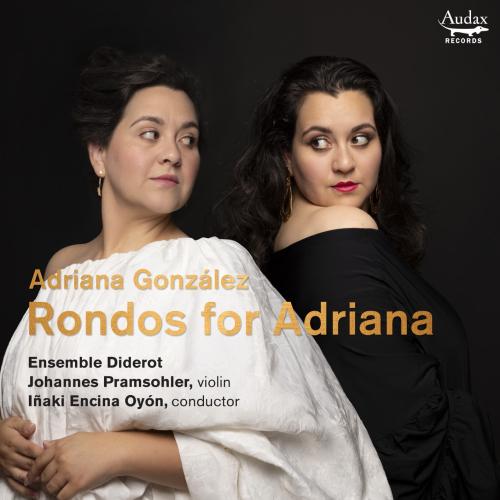
Artist: Adriana González, Ensemble Diderot, Johannes Pramsohler & Iñaki Encina Oyón
Composer: Antonio Soler (1729-1783), Wolfgang Amadeus Mozart (1756-1791), Giuseppe Giordani (1751-1798), Ferdinando Bertoni (1725-1813), Pasquale Anfossi (1727-1797), Karl Weigl (1881-1949), Angelo Tarchi (1760-1814)
Album including Album cover Booklet (PDF)
- Vicent Martín i Soler (1754 - 1806): L'arbore di Diana, Act II Scene 14:
- 1 Soler: L'arbore di Diana, Act II Scene 14: I. Recit. Cessa, cessa mio core (Diana) (96 kHz) 01:35
- 2 Soler: L'arbore di Diana, Act II Scene 14: II. Rondò. Teco porta, o mia Speranza (Diana) (96 kHz) 04:59
- Angelo Tarchi (ca. 1760 - 1814): Il conte di Saldagna:
- 3 Tarchi: Il conte di Saldagna: I. Recit. Ah! Se tu m'ami (Diana) (96 kHz) 01:45
- 4 Tarchi: Il conte di Saldagna: II. Rondò. Ah! Sol bramo, o mia Speranza (Diana) (96 kHz) 06:06
- Wolfgang Amadeus Mozart (1756 - 1791): Le Nozze di Figaro, K. 577, Act IV Scene 10:
- 5 Mozart: Le Nozze di Figaro, K. 577, Act IV Scene 10: I. Recit. Giunse al fin il momento (Susanna) 01:18
- 6 Mozart: Le Nozze di Figaro, K. 577, Act IV Scene 10: II. Rondò. Al desio di chi t'adora (Susanna) 06:02
- Rondo in C Major for Violin and Orchestra, K. 373:
- 7 Mozart: Rondo in C Major for Violin and Orchestra, K. 373 06:06
- Le Nozze di Figaro, K. 577, Act III Scene 8:
- 8 Mozart: Le Nozze di Figaro, K. 577, Act III Scene 8: I. Recit. E Susanna non vien (Contessa) 01:34
- 9 Mozart: Le Nozze di Figaro, K. 577, Act III Scene 8: II. Rondò. Dove sono i bei momenti (Contessa) 04:32
- Ferdinando Gasparo Bertoni (1725 - 1813): Balthassar:
- 10 Bertoni: Balthassar: Rondoncino. Mater cara, extremum vale (Jezael) 04:36
- Giuseppe Giordani (1751 - 1798): Erifile:
- 11 Giordani: Erifile: I. Recit. In quale istante 02:20
- 12 Giordani: Erifile: II. Rondò. Partirò dal caro bene 04:56
- Pasquale Anfossi (1727 - 1797): Sedecias:
- 13 Anfossi: Sedecias: Rondò. Se mi lasci, o mia Speranza (Didone) 05:02
- Joseph Weigl (1766 - 1846): Recit. Ah che in van cerco pace:
- 14 Weigl: Recit. Ah che in van cerco pace 01:37
- Aria. Giusti numi amor pietoso:
- 15 Weigl: Aria. Giusti numi amor pietoso 05:02
- Wolfgang Amadeus Mozart: Rondo (Rondeaux) in B-flat Major for Violin and Orchestra, K. 269, (261a):
- 16 Mozart: Rondo (Rondeaux) in B-flat Major for Violin and Orchestra, K. 269, (261a): Rondo in B-Flat Major for Violin and Orchestra, K. 269/261a 07:21
- Così fan tutte, K. 588, Act II Scene 7:
- 17 Mozart: Così fan tutte, K. 588, Act II Scene 7: I. Recit. Ei parte… senti… Ah no! (Fiordiligi) 01:42
- 18 Mozart: Così fan tutte, K. 588, Act II Scene 7: II. Rondò. Per pietà, ben mio, perdona (Fiordiligi) 07:10
Info for Rondos for Adriana
Everybody knows Fiordiligi’s rondò from Così fan tutte, but who was the singer behind it? Adriana Ferrarese del Bene from Udine numbered among the great prima donnas of the time and was always good for a scandal: she fled surreptitiously from the Venetian Ospedale dei Mendicanti, was Lorenzo da Ponte’s mistress in Vienna, and sang in Reggio as the first prima donna on Italy with the tricolor on her dress. Throughout her eventful career, the rondò was her constant companion: the large dramatic aria in two parts of which not only Mozart was a master. Giuseppe Sarti, Pasquale Anfossi, and Angelo Tarchi were the true masters of the rondò in Italy. Adriana Ferrarese performed their music so poignantly that audiences in Milan’s La Scala and the London Opera went crazy.
A young prima donna of today relates the life story of la Ferrarese in major arias: Adriana González. By coincidence she bears the same first name. Her voice volume, her radiant high notes and astonishing control over her instrument make her the ideal “Adriana.” Since winning first prize at Placido Domingo’s “Operalia” in 2019, the opera world lies at her feet. With her program “Rondò,” she builds a bridge between Mozart and the music of his forgotten contemporaries in Italy.
Adriana González, soprano
Johannes Pramsohler, solo violin
Ensemble Diderot
Iñaki Encina Oyón, conductor
Please Note: This album consists of different sampling rates. See track list - behind each track you'll find the sampling rate.
Adriana González
First Prize and Zarzuela Prize of the Operalia Competition 2019, acclaimed for her fine lyric voice and outstanding musicality, young performer Adriana González is one of the most promising singers of her generation.
González is known for singing roles such as Mimì (La Bohème) at the Opéra de Toulon & the Gran Teatre del Liceu, Micaela (Carmen) at the Opéra National de Paris, Dutch National Opera, Grand Théâtre du Genève, Soirées Lyriques du Sanxay, Oper Frankfurt, Liù (Turandot) at the Opéra de Toulon and Houston Grand Opera, and Countess (Le Nozze di Figaro) at the Opéra National de Lorraine, Théâtres de la Ville de Luxembourg & Oper Frankfurt, Juliette (Roméo et Juliette) at the Houston Grand Opera, Pamina (Die Zauberflöte) at the Oper Burg Gars, Corinna (Il viaggio a Reims) at the Gran Teatro Liceu in Barcelona, and Lia (Debussy‘s L’Enfant Prodigue) at the Nancy Opera House.
Born in Guatemala in 1991, González begun her studies with Barbara Bickford shortly after finishing high school in 2008. A year after studying with Bickford, González won the New Upcoming Artist Award presented by the Hemeroteca Nacional de Guatemala. She studied at the Universidad del Valle de Guatemala, graduating with a Music Teaching Degree & a Bachelor of Arts in 2012.
In 2012 González is discovered by basque conductor Iñaki Encina Oyón during a tour with the World Youth Choir in Cyprus, subsequently inviting her to perform in Paris in 2013. Shortly after she is heard by Christian Schirm and is invited to become member of the Atelier Lyrique de l’Opéra national de Paris, where she sung Zerlina (Don Giovanni) & Despina (Così fan tutte). On completing the Atelier Lyrique programme, Adriana won the 2017 Prix Lyrique du Cercle Carpeaux for her outstanding development.
From 2017-2018, she joined the Zurich Opera’s International Opera Studio, by invitation of coach and director Brenda Hurley.
During her Paris years, González won several prizes in international competitions: Third Prize at the «Veronica Dunne International Singing Competition» in Ireland, First Prize at the «Otto Edelmann Singing Competition» in Vienna, the Oper Burg Gars Prize, Second Prize and Public Choice Prize at the «Francisco Viñas International Singing Contest» at the Liceu Barcelona, as well as the Prize of the Teatro Real in Madrid, the Associació d’Amics de l’Ópera Prize in Sabadell, the Internationale OpernWerkstatt Prize.
Her first recording devoted to Robert Dussaut & Hélène Covatti Melodies, with Iñaki Encina Oyón at the piano, released in the Spring 2020 by Audax Records, is warmly welcomed by the critics and received the “Preis der deutschen Schallplattenkritik”, and was selected by Le Monde.
As González and Encina continue to work on lied/mélodie, they focus on re-discovering unknown composers, which can be heard at the LIFE Victoria Festival in Barcelona, Opéra de Lille, Opéra de Dijon and Teatro de la Zarzuela in Madrid.
Continuing to add roles to her repertoire, González consistently works with vocal technique teachers Michelle Wegwart & Hedwig Fassbender, along with conductor Iñaki Encina Oyón and coaches Alfredo Abbati & Margaret Singer.
González's forthcoming roles include: Micaëla (Carmen) at the Opéra de Toulon, Liù at the Opéra National du Rhin and Staatsoper Hamburg, and Contessa Almaviva at the Salzburg Festival, marking her debut in Salzburg.
Booklet for Rondos for Adriana