



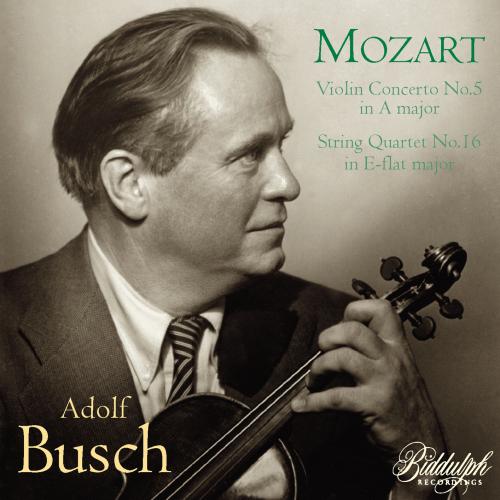
Adolf Busch (Remastered 2026) Adolf Busch
Album info
Album-Release:
2026
HRA-Release:
20.10.2026
Label: Biddulph Recordings
Genre: Classical
Subgenre: Instrumental
Artist: Adolf Busch
Composer: Johann Sebastian Bach (1685-1750), Georg Friedrich Händel (1685-1759), Francesco Geminiani (1687-1762), Johannes Brahms (1833-1897)
Album including Album cover Booklet (PDF)
- Wolfgang Amadeus Mozart (1756 - 1791): String Quartet No 16 in E-flat, K.428:
- 1 Mozart: String Quartet No 16 in E-flat, K.428: Allegro non troppo 07:44
- 2 Mozart: String Quartet No 16 in E-flat, K.428: Andante con moto 05:24
- 3 Mozart: String Quartet No 16 in E-flat, K.428: Menuetto: Allegro 06:40
- 4 Mozart: String Quartet No 16 in E-flat, K.428: Allegro vivace 04:43
- Violin Concerto No.5 in A, K.219:
- 5 Mozart: Violin Concerto No.5 in A, K.219: Allegro aperto – Adagio – Allegro aperto 08:32
- 6 Mozart: Violin Concerto No.5 in A, K.219: Adagio 09:59
- 7 Mozart: Violin Concerto No.5 in A, K.219: Rondeau: Tempo di Menuetto 08:05
- Arcangelo Corelli (1653 - 1713): Adagio from Violin Sonata in F, op.5 no.10:
- 8 Corelli: Adagio from Violin Sonata in F, op.5 no.10 02:46
- Giuseppe Tartini (1692 - 1770): Adagio from Violin Sonata, op.2 no.12:
- 9 Tartini: Adagio from Violin Sonata, op.2 no.12 04:07
- Johann Sebastian Bach (1685 - 1750): Violin Sonata in E minor, BWV 1023:
- 10 Bach: Violin Sonata in E minor, BWV 1023: (Allegro) 00:57
- 11 Bach: Violin Sonata in E minor, BWV 1023: Adagio ma non tanto 03:33
- 12 Bach: Violin Sonata in E minor, BWV 1023: Allemande 02:10
- 13 Bach: Violin Sonata in E minor, BWV 1023: Gigue 01:55
- George Frideric Handel (1685 - 1759): Violin Sonata in A, HWV 361:
- 14 Handel: Violin Sonata in A, HWV 361: Larghetto 02:12
- 15 Handel: Violin Sonata in A, HWV 361: Allegro 01:46
- 16 Handel: Violin Sonata in A, HWV 361: Adagio 00:55
- 17 Handel: Violin Sonata in A, HWV 361: Allegro 02:54
- Johannes Brahms (1833 - 1897): Hungarian Dance No 18 in D (arr. Joachim) (arr. Joachim):
- 18 Brahms: Hungarian Dance No 18 in D (arr. Joachim) (arr. Joachim) 01:12
- Hungarian Dance No.20 in D Minor (arr. Joachim) (arr. Joachim):
- 19 Brahms: Hungarian Dance No.20 in D Minor (arr. Joachim) (arr. Joachim) 01:41
- Francesco Geminiani (1687 - 1762): Sicilliana from Sonata in C Minor, Op.4 No.20:
- 20 Geminiani: Sicilliana from Sonata in C Minor, Op.4 No.20 03:47
Info for Adolf Busch (Remastered 2026)
Adolf Busch is primarily remembered today as the leader of his eponymous string quartet, perhaps the greatest chamber music ensemble in the first half of the 20th century. Although the Busch Quartet recorded twelve of Beethoven's 16 string quartets, they only recorded the one Mozart quartet featured on this release. Mozart String Quartet No.16 in E-flat is one of Mo-zart '10 celebrated quartets', six of which were dedicated to the com-poser's older friend and colleague Joseph Haydn. After receiving the dedication, Haydn wrote to Mozart's father: 'Before God, I declare that your son is the greatest composer known by me in person or by reputation.' For most of his career, Busch primarily recorded chamber music, including duo sonatas with the pianist Rudolf Serkin (who later be-came the violinist's son-in-law). Nevertheless, Busch had a brilliant violin technique, and after he emigrated to the United States from Nazi Germany, the American Columbia label asked Busch to record several solo violin concertos in the early 1940s. Besides concertos by Bach and Beethoven, Busch made the recording of Mozart's Violin Concerto No.5 in A - his only recording of a concerto by the Salz-burg master - in 1945. Also included on this CD are all the solo works Busch made with the pianist Artur Balsam in 1942. Recorded at New York's Columbia Studios, these include two Baroque violin sonatas by Bach and Han-del, a Siciliana by Geminiani and two Hungarian Dances by Brahms.
Adolf Busch, 1st violin
Gosta Andreasson, 2nd violin
Busch String Quartet
Digitally remastered
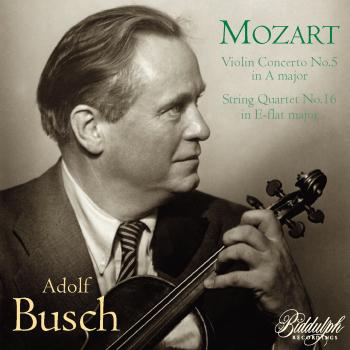
Adolf Busch
The son of violin maker Wilhelm Busch (1860–1929) and brother of conductor and opera director Fritz Busch (1890–1951), actor Willi Busch (1893–1951), cellist Hermann Busch (1897–1975), and pianist and composer Heinrich Busch (1900–1929), he received his initial instruction from his father and composed his first symphony around 1902. From 1902 to 1908, he studied at the Cologne Conservatory (North Rhine-Westphalia), where he received training in violin from Willi Heß (1859–1939) and Bram Eldering (1865–1943), composition from Fritz Steinbach (1855–1916), and chamber music from Carl Friedberg (1872–1955). Having become close friends with Max Reger (1873–1916) in 1907, he continued his composition studies in Bonn (North Rhine-Westphalia) in 1908 under Hugo Grüters (1851–1928), who would later become his father-in-law.
In 1912, Adolf Busch became concertmaster of the Konzert-Verein Orchestra in Vienna and founded the Vienna Konzert-Verein Quartet. In 1913, he married the economist Frieda Grüters (1891–1946). The couple spent their honeymoon at the home of the art patron Jenny Mautner (1856–1938) and her husband, the industrial magnate Isidor Mautner (1852–1930)—who, from 1925, was also the owner of the Marienthal textile factory. Adolf and Frieda Busch had one daughter, Irene Busch (1917–1999), who married the pianist Rudolf Serkin (1903–1991) in 1935.
In 1918, Adolf Busch became a teacher at the Berlin University of the Arts (Hochschule für Musik). In 1919, he founded the renowned Busch Quartet, and in 1920, he formed a trio with his brother Hermann Busch and Rudolf Serkin (1903–1991)—who would later become his son-in-law. In 1922, Adolf Busch moved to Darmstadt (Hesse).
In 1927, Adolf Busch relocated to Basel (Basel-Stadt). After being stripped of his citizenship by the National Socialist regime in 1933, he was granted Swiss citizenship in 1935. That same year, he co-founded the Busch Chamber Orchestra. In 1937, he declined an invitation to perform a concert in Germany.
In 1939, Adolf Busch moved to the United States, settling in New York City. In 1950, together with Rudolf Serkin and Marcel Moyse (1889–1984), he founded a music school in Marlboro, Vermont (which later became the Marlboro Music Festival). Following the death of his wife, Adolf Busch married Hedwig Vischer (born 1916)—the daughter of a physician—in 1947; the couple had two sons.
Adolf Busch, who left behind more than seventy compositions, is regarded today as one of the most significant violinists of the 20th century. (Reinhard Müller)
Booklet for Adolf Busch (Remastered 2026)