



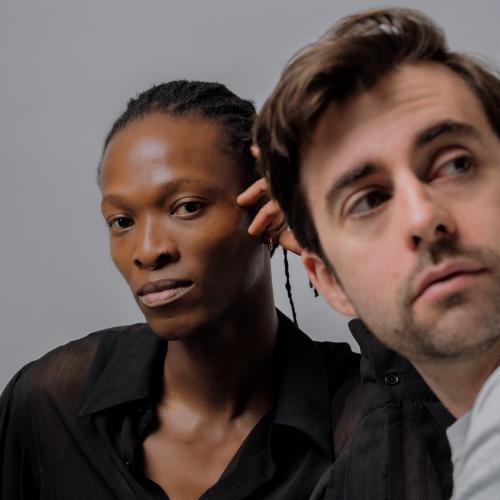
Invocation Vuyo Sotashe & Chris Pattishall
Album info
Album-Release:
2026
HRA-Release:
20.03.2026
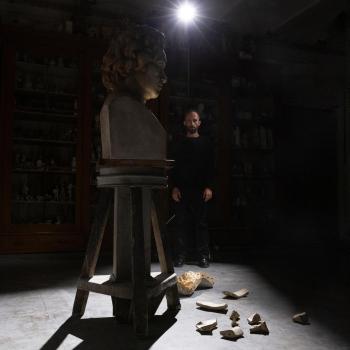
Album including Album cover
- 1 I'll Look Around 07:11
- 2 I Got It Bad (And That Ain't Good) 03:21
- 3 I Think It's Gonna Rain Today 06:09
- 4 Sylvia 03:52
Info for Invocation
Invocation, the duo EP from Vuyo Sotashe and Chris Pattishall, will be available March 20, 2026. Distinguished by the duo’s penchant for disarming vulnerability and patience, this is a recorded testimony of time told slowly, tracing the gnarled roots of ancestral knowledge into a forest in full bloom.
Having created together for many years in various configurations and international tours, Sotashe and Pattishall started regularly performing as a duo in 2020. Following a residency at renowned venue Joe’s Pub as New York Voices artists, the duo went into the studio to document their developing approach. Restrained, focused, and leaning into quiet ambiguity, the music evolves slowly, a hushed invocation of community in the midst of turbulent times.
Invocation was co-produced by Rafiq Bhatia (Oscar-nominated composer and member of Son Lux) and Eric Oberstein (Grammy award-winning producer). Bhatia, who mixed the album, brings a surreal intimacy to the proceedings, highlighting subtle details of phrasing and timbre and adding evocative dimension to the music.
Invocation follows on the release They Say I Look Like God (released October 2023). The duo are featured on Son Lux’s Alternate Forms, a collaborative reimagining of the band’s album Lanterns. Vuyo’s and Chris’s contribution - an otherworldly rendition of the anthemic song Easy - was described by Son Lux frontman Ryan Lott as “so deft and surgically spare it’s bracing - when I first heard it, I felt caught in slow motion.”
“... pushing and pulling with practiced ease like dancers taking turns to lead. They absolutely enchanted a sold-out audience, [with] Sotashe’s radiant warmth and enveloping voice, alongside Pattishall’s elegant and fluid expressions on the piano.” — Esplanade
Vuyo Sotashe, vocals
Chris Pattishall, piano
Vuyo Sotashe
Young South African jazz vocalist, Vuyo (Vuyolwethu) Sotashe, is gradually making his mark in the New York jazz scene. Sotashe moved to the NYC in 2013 after being awarded the prestigious Fulbright Scholarship to pursue Master of Music (Spring 2015) at William Paterson University. Since then, he has gone to win first prize at the very first Mid-Atlantic Jazz Festival Vocal Competition in 2014, and performed on the festival's main stage in February of 2015. More recently, he won the Audience prize award and placed second over-all at the Shure Montreux Jazz Voice Competition in 2015, held at the annual Montreux Jazz Festival in Switzerland. In the same he placed third in the prestigious Thelonious Monk Institute International Jazz Vocal competition, where he was the very first male vocalist ever to place in the competition's finals.
Vuyo Sotashe has also performed on international stages which include singing at the Arcevia Jazz Fest and the Fermo Jazz Festival in Italy 2012; the Stockholm Jazz Festival with South African National Youth Jazz Band in Sweden 2012; at the Cape Town International Festival with George Benson and the Cape Town Symphony Orchestra 2010; the Johannesburg Joy of Jazz Festival 2012; and he has toured with the SAMA Award (GRAMMY equivalent) winning band Proxy in the UK and Ireland 2009-2011. He has also performed with Multi-Grammy Award winning gospel artist, Israel Houghton as part of New Breed (Africa) Ensemble.
Sotashe is also the winner of the biggest music scholarship competition in South Africa, the South African Music Rights Foundation Scholarship, where he performed for the former South African President Thabo Mbeki. Vuyo Sotashe is currently performing around New York City with the praised drummer Winard Harper, who has performed with the likes of Betty Carter, Shirley Horn, and many other legends in jazz.
Chris Pattishall
Like many of his favorite things, there is much more to Chris Pattishall than meets the eye, and it gets stranger the deeper you dig. Most know him as a pianist with a “forthright relationship to the jazz tradition” (New York Times) and a hard-earned endorsement from the music’s traditional establishment—Wynton Marsalis once shortlisted Pattishall among his favorite young improvisers, and he’s also worked with Jimmy Heath, Jon Hendricks, and Wycliffe Gordon.
Though he makes his living moonlighting as a besuited scholar of Earl Hines and Erroll Garner, you’re more likely to find Pattishall in a wolf sweatshirt when he’s off the clock, passing through the Gladstone Gallery to experience the latest from Wangechi Mutu or heading to the Armory to check out Oneohtrix Point Never. Pattishall traces his fascination with the surreal to his childhood in Durham, North Carolina. His father, who once wrote a Masters’ thesis on the magical realism of Gabriel García Márquez, kept a keenly-curated collections of LPs, films, and books that served as an important early influence. But it was at a friend’s house that Pattishall first encountered Buñuel’s The Exterminating Angel, a watershed moment that was matched only by his first exposure to Thelonious Monk’s pianism. “There’s something about the way that Monk plays—part of it you recognize, but the other part of you can’t tell if he broke the piano; you can’t tell how the sound is created. I felt that in this particular film, and that opened me up to experiencing other things.”
It was within this broader context that Pattishall’s relationship to the piano developed. His parents had brought him a Casio keyboard at age eight, imposing what he describes as a “five-year prison sentence” where he was forced to take lessons. But it wasn’t until his teens that Pattishall’s interest in the instrument truly flourished. He quickly became one of the most in-demand pianists in the region, often working multiple nights a week and going on his first tour before he could legally drive. A pivotal shift came when Chris began studying with Marcus Roberts, a process which led him to a deep affinity for pre-bebop jazz. “I started to notice all of this idiosyncrasy in the early music that I wasn’t hearing in later stuff which also connected rhythmically to what I was drawn to in hip-hop—the emphasis on the beat and the way the rhythm had a little more weight to it. You also start realizing as you dig into the details that the way these things get reduced in pedagogy and criticism totally fails to pay homage to how wild and irregular and personal all of these artists were.”
Through this deep dive into history, Pattishall has taken an important step towards finding the common thread that binds his broad interests. “The thing I’ve learned that I’ve been slow to implement is that you just have to 100% do your own thing. You don’t need affirmation from other people. If you believe in something, you gotta just keep hammering away at it.”
This album contains no booklet.