

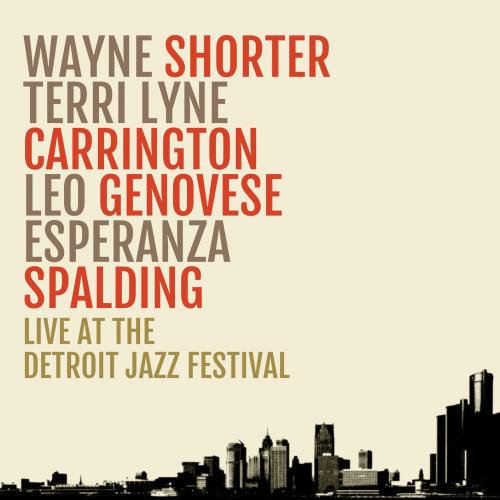
Live At The Detroit Jazz Festival (Live) Wayne Shorter, Terri Lyne Carrington, Leo Genovese, Esperanza Spalding
Album info
Album-Release:
2022
HRA-Release:
05.03.2026
Label: Candid
Genre: Latin
Subgenre: Bossa Nova
Artist: Wayne Shorter, Terri Lyne Carrington, Leo Genovese, Esperanza Spalding
Album including Album cover
- 1 Someplace Called "Where" (Live) 14:20
- 2 Endangered Species (Live) 21:43
- 3 Encontros e Despedidas (Live) 08:38
- 4 Drummers Song (Live) 04:41
- 5 Midnight in Carlotta's Hair (Live) 06:16
Info for Live At The Detroit Jazz Festival (Live)
A really unique lineup, coming together in a really unique performance -- one that definitely pushes the boundaries of all artists involved, and makes for music that's beyond any expectations you might have for the players! The tracks are long, and the music is often quite free and improvised at times -- loose, open, and wonderfully experimental -- yet still filled with the individual strengths and souls of each of the players -- Wayne Shorter on tenor and soprano, Leo Genovese on piano, Terri Lyne Carrington on drums, and Esperanda Spaulding on bass and vocals -- the latter of which are nicely different here than on her own albums. There's definitely some of the darker currents that Shorter has brought to his music in the past two decades -- and titles include "Someplace Called Where", "Endangered Species", "Encontros E Despedidas", "Drummers Song", and "Midnight In Carlotta's Hair".
"In 2017, Wayne Shorter was artist-in-residence at the Detroit Jazz Festival. He was scheduled to perform three times during the weekend: Once with his longstanding quartet -- pianist Danilo Perez, drummer Brian Blade, and bassist John Patitucci -- the second was the quartet performance documented here. The third set was to be a live performance of Emanon, the score for his graphic novel with an orchestra; it was cancelled due to inclement weather. This group comprised bassist/vocalist Esperanza Spalding, drummer Teri Lyne Carrington, and pianist Leo Genovese (he replaced Detroit pianist Geri Allen, who died in June). The group met that day to rehearse a few themes, but no more. Live at the Detroit Jazz Festival showcases a band carrying on an eventful, musically advanced conversation.
Opener "Someplace Called 'Where'" was composed by Shorter. Spalding, and Genovese, and Carrington's ride cymbal introduces it haltingly. Shorter's tenor enters at 1:30 and the band begins framing his questioning notes. Spalding starts singing at two minutes. Her long, open notes in the lyric flower within the quartet's accompaniment. and emerge, slowly yet fully formed as a clarion call to explore. Solos by Genovese and Shorter are reaching and resonant. Carrington's dancing rhythms anchor, push, and underscore their unconventional harmonic invention. More than 21 minutes long, "Endangered Species," was co-composed by Shorter and Spalding (they later collaborated on the staged opera Iphigenia). It emerges subtly: Soprano sax punctuates the chordal statements by Genovese and the percussive vamping of Spalding with Carrington's stretched beats melding post-bop and funky breaks. At five minutes, soprano sax and piano deliver a forceful call-and-response modal interaction. The music strips to a hush halfway through as Spalding's voice offers solace and assurance with crystalline accuracy while elastically shifting pitches. A glorious reading of Milton Nascimento's "Encontros e Despedidas" follows (Shorter cut 1975's Native Dancer in collaboration with him). Spalding is exceptional with the Portuguese lyric, allowing her voice freedom amid Carrington's shifting polyrhythms as Shorter's tenor offers an alternate lyricism framed by Genovese's cascading arpeggios and lush chords. Allen's "Drummer's Song" commences with Afro-Latin drumming and Genovese's syncopated chord voicings. Spalding's bass enters halfway into a circular vamp that the pianist transforms into mutant salsa as Shorter's soprano punctuates with sweeping, jagged lines in an intoxicating, swirling dance. The saxophonist's "Midnight in Carlotta's Hair" is the set closer. The empathic union of singer and soprano horn reaches deep into Shorter's complex, canny lyricism. Carrington and Genovese add depth, color, dimension, and constant fluid motion. The band gels as Shorter solos before the quartet reunites in a gradual fade. This group's individual and collective abilities reflect a more seasoned quartet. Live at the Detroit Jazz Festival is a compelling exercise in kinetic, deeply emotional music making (mostly) in the moment . Given Shorter's retirement from performing (he is 89 with health issues) this amounts to a gift as well as a historical document." (Thom Jurek, AMG)
Wayne Shorter, soprano & tenor saxophone
Terri Lyne Carrington, drums
Leo Genovese, keyboards, piano
Esperanza Spalding, bass, vocals
Recorded September 3, 2017 at Detroit International Jazz Festival
Please Note: We offer this album in its native sampling rate of 48kHz, 24-bit. The provided 96kHz version was up-sampled and offers no audible value!
Wayne Shorter
Though some will argue about whether Wayne Shorter's primary impact on jazz has been as a composer or as a saxophonist, hardly anyone will dispute his overall importance as one of jazz's leading figures over a long span of time. Though indebted to a great extent to John Coltrane, with whom he practiced in the mid-'50s while still an undergraduate, Shorter eventually developed his own more succinct manner on tenor sax, retaining the tough tone quality and intensity and, in later years, adding an element of funk. On soprano, Shorter is almost another player entirely, his lovely tone shining like a light beam, his sensibilities attuned more to lyrical thoughts, his choice of notes becoming more spare as his career unfolded. Shorter's influence as a player, stemming mainly from his achievements in the 1960s and '70s, has been tremendous upon the neo-bop brigade who emerged in the early '80s, most notably Branford Marsalis. As a composer, he is best known for carefully conceived, complex, long-limbed, endlessly winding tunes, many of which have become jazz standards yet have spawned few imitators.
Shorter started on the clarinet at 16 but switched to tenor sax before entering New York University in 1952. After graduating with a BME in 1956, he played with Horace Silver for a short time until he was drafted into the Army for two years. Once out of the service, he joined Maynard Ferguson's band, meeting Ferguson's pianist Joe Zawinul in the process. The following year (1959), Shorter joined Art Blakey's Jazz Messengers, where he remained until 1963, eventually becoming the band's music director. During the Blakey period, Shorter also made his debut on records as a leader, cutting several albums for Chicago's Vee-Jay label. After a few prior attempts to hire him away from Blakey, Miles Davis finally convinced Shorter to join his Quintet in September 1964, thus completing the lineup of a group whose biggest impact would leap-frog a generation into the '80s.
Staying with Miles until 1970, Shorter became at times the band's most prolific composer, contributing tunes like 'E.S.P.,' 'Pinocchio,' 'Nefertiti,' 'Sanctuary,' 'Footprints,' 'Fall' and the signature description of Miles, 'Prince of Darkness.' While playing through Miles' transition from loose post-bop acoustic jazz into electronic jazz-rock, Shorter also took up the soprano in late 1968, an instrument which turned out to be more suited to riding above the new electronic timbres than the tenor. As a prolific solo artist for Blue Note during this period, Shorter expanded his palette from hard bop almost into the atonal avant-garde, with fascinating excursions into jazz/rock territory toward the turn of the decade.
In November 1970, Shorter teamed up with old cohort Joe Zawinul and Miroslav Vitous to form Weather Report, where after a fierce start, Shorter's playing grew mellower, pithier, more consciously melodic, and gradually more subservient to Zawinul's concepts. By now, he was playing mostly on soprano, though the tenor would re-emerge more toward the end of WR's run. Shorter's solo ambitions were mostly on hold during the WR days, resulting in but one atypical solo album, Native Dancer, an attractive side trip into Brazilian-American tropicalismo in tandem with Milton Nascimento. Shorter also revisited the past in the late '70s by touring with Freddie Hubbard and ex-Miles sidemen Herbie Hancock, Ron Carter, and Tony Williams as V.S.O.P.
Shorter finally left Weather Report in 1985, but promptly went into a creative slump. Still committed to electronics and fusion, his recorded compositions from this point became more predictable and labored, saddled with leaden rhythm sections and overly complicated arrangements. After three routine Columbia albums during 1986-1988, and a tour with Santana, he lapsed into silence, finally emerging in 1992 with Wallace Roney and the V.S.O.P. rhythm section in the 'A Tribute to Miles' band. In 1994, now on Verve, Shorter released High Life, a somewhat more engaging collaboration with keyboardist Rachel Z.
In concert, he has fielded an erratic series of bands, which could be incoherent one year (1995), and lean and fit the next (1996). He guested on the Rolling Stones' Bridges to Babylon in 1997, and on Herbie Hancock's Gershwin's World in 1998. In 2001, he was back with Hancock for Future 2 Future and on Marcus Miller's M². Footprints Live! was released in 2002 under his own name, followed by Alegría in 2003 and Beyond the Sound Barrier in 2005. Given his long track record, Shorter's every record and appearance are still eagerly awaited by fans in the hope that he will thrill them again. Blue Note Records released Blue Note's Great Sessions: Wayne Shorter in 2006. (Richard S. Ginell). Source: Blue Note Records.
This album contains no booklet.