



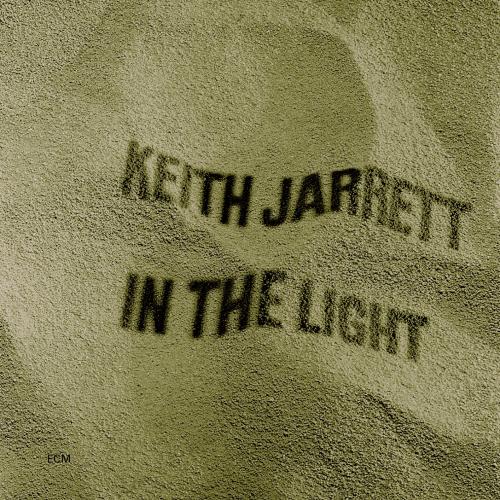
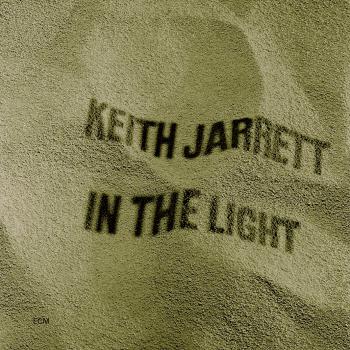
In The Light (Remastered) Keith Jarrett
Album info
Album-Release:
1974
HRA-Release:
30.01.2026
Album including Album cover
I`m sorry!
Dear HIGHRESAUDIO Visitor,
due to territorial constraints and also different releases dates in each country you currently can`t purchase this album. We are updating our release dates twice a week. So, please feel free to check from time-to-time, if the album is available for your country.
We suggest, that you bookmark the album and use our Short List function.
Thank you for your understanding and patience.
Yours sincerely, HIGHRESAUDIO
- 1 Metamorphosis 19:23
- 2 Fughata For Harpsichord 05:29
- 3 Brass Quintet 20:53
- 4 A Pagan Hymn 07:31
- 5 String Quartet (Keith Jarrett) 16:41
- 6 Short Piece For Guitar And Strings 03:56
- 7 Crystal Moment 04:58
- 8 In The Cave, In The Light 12:18
Info for In The Light (Remastered)
One look at my other Keith Jarrett reviews is enough to confirm that I have been guilty of separating his skills as performer and improviser from those of his role as composer. After listening to an album such as In The Light, however, I begin to suspect that for him they are one and the same.
The lush flavors of Metamorphosis for flute and strings are a most substantial appetizer to the many courses that follow in this early foray into larger territories. Soloist Willi Freivogel soars through the orchestra’s empty skies with a free and easy charm, bringing a pastoral sound in which memory is more than recreated; it is relived. Jarrett’s balance of density and linearity speaks with the same sense of total concentration and calculated surrender to the melodic moment as his most admirable improvisations. Moods and techniques take sudden turns, as in a particularly inventive passage during which the members of the orchestra tap their instruments for a pointillist interlude. The album has its fair share of similarly expansive works, including the enchanting Short Piece For Guitar And Strings (with Ralph Towner on nylon), and the anthemic In The Cave, In The Light (pairing Jarrett on piano, gong, and percussion with orchestra). While the latter two never quite scale the heights of Metamorphosis, they are so distinctly realized that one is hard-pressed to make a case for such comparisons. A smattering of chamber works rounds out this ambitious double effort, of which the String Quartet is the most appealing. Its pseudo-neoclassical style is sharp, taut, and uplifting. Unfortunately, Crystal Moment for four celli and two trombones doesn’t work so much for me, and seems to meander from the album’s otherwise steady path. The Brass Quintet, on the other hand, is a wonderful hybrid of timbres and chameleonic styles. Two solo pieces, Fughata for Harpsichord and A Pagan Hymn (both played by Jarrett on piano), provide the sharpest angles in a gospel-Baroque pastiche.
Overall, the idiomatic slipperiness of In The Light keeps us on our toes and ensures that we never outstay our welcome in any given label. Though perhaps a daunting journey to take in one sitting, it is nevertheless a deep insight into one of contemporary music’s most fascinating figures. These orchestral projects are in some ways Jarrett’s most “experimental.” Then again, isn’t experimentation what music is all about? (ecmreviews.com)
Keith Jarrett, piano, gong, percussion, conductor
String Section of the Südfunk Symphony Orchestra, Stuttgart
Mladen Gutesha, conductor
The American Brass Quintet
The Fritz Sonnleitner Quartet
Ralph Towner, guitar
Willi Freivogel, flute
Digitally remastered
Keith Jarrett
At the end of 2008, Keith Jarrett added two concerts to his schedule at short notice – one at Paris’s Salle Pleyel (November 26), one at London’s Royal Festival Hall (December 1) . The music on “Testament” is from these concerts. Their range is compendious, Jarrett’s improvisational imagination continually uncovering new forms, in a music stirred by powerful emotions. In his liner notes, the pianist is forthright about the personal circumstances promoting a need to lose himself in the work once more.
He also reminds the reader/listener that “it is not natural to sit at a piano, bring no material, clear your mind completely of musical ideas and play something that is of lasting value and brand new.” This, however, has been the history and substance of the solo concerts since Jarrett initiated them, almost forty years ago . Over time their connection to ‘jazz’ has often become tenuous, yet Jarrett’s solo concerts, with the foregrounding of melody and the continual building, and relinquishing, of structure, are also removed from “free improvisation” as a genre. Jarrett’s solo work is effectively its own idiom, and has been subject to periodic revisions by the pianist. “In the early part of this decade, I tried to bring the format back: starting from nothing and building a universe.”
Since the “Radiance” album and the “Tokyo Solo” DVD of 2002 Jarrett has been adjusting the flow of the work, more often working with shorter blocks of material. “I continued to find a wealth of music inside this open format, stopping whenever the music told me to.” This approach distinguished “The Carnegie Hall Concert” (2006), and it is most effectively deployed in “Testament” , where the strongly-contrasting elements of the sections of the Paris concert in particular have the logic of a spontaneously-composed suite. The nerves-bared London performance (the first UK solo show in 18 years) is different again: “The concert went on and, though the beginning was a dark, searching, multi-tonal melodic triumph, by the end it somehow became a throbbing, never-to-be-repeated pulsing rock band of a concert (unless it was a church service, in which case, Hallelujah!).”
In the end, the improviser does what must be done. As Keith Jarrett said, a long time ago, “If you’re a rock climber, once you’re halfway up the face of the cliff, you have to keep moving, you have to keep going somewhere. And that’s what I do, I find a way.”
These days, however, Jarrett is rationing the number of ascents: there have been less than thirty solo concerts in the last decade, making “Testament” a special event indeed. Two further solo performances are scheduled for 2009 – at the Palais des Beaux Arts in Brussels on October 9, and at Berlin’s Philharmonie on October 12.
This album contains no booklet.